
We commit the cardinal sin of research: We decide what story we want to tell before we collect the data.
To a purist academic, this sounds like heresy. It sounds like confirmation bias wrapped in a marketing budget.
But you aren’t writing for a peer-reviewed journal in 1995. You are competing for the attention of over-stimulated executives who haven’t finished a white paper since the Blackberry was cool.
The traditional approach is to “mine for insights.” You collect a mountain of data, stare at it until your eyes bleed, and hope a story magically appears.
This is the Mining Fallacy.
It is inefficient. It is expensive. And it usually results in a report that is technically accurate but strategically useless.
If Rocky Balboa was a content strategist, he wouldn’t run up the steps of the Philadelphia Museum of Art hoping to find a boxing match at the top. He would book the fight first, then train specifically to win it.
This guide introduces the Narrative-First Operating Model. We don’t randomly explore; we engineer authority.
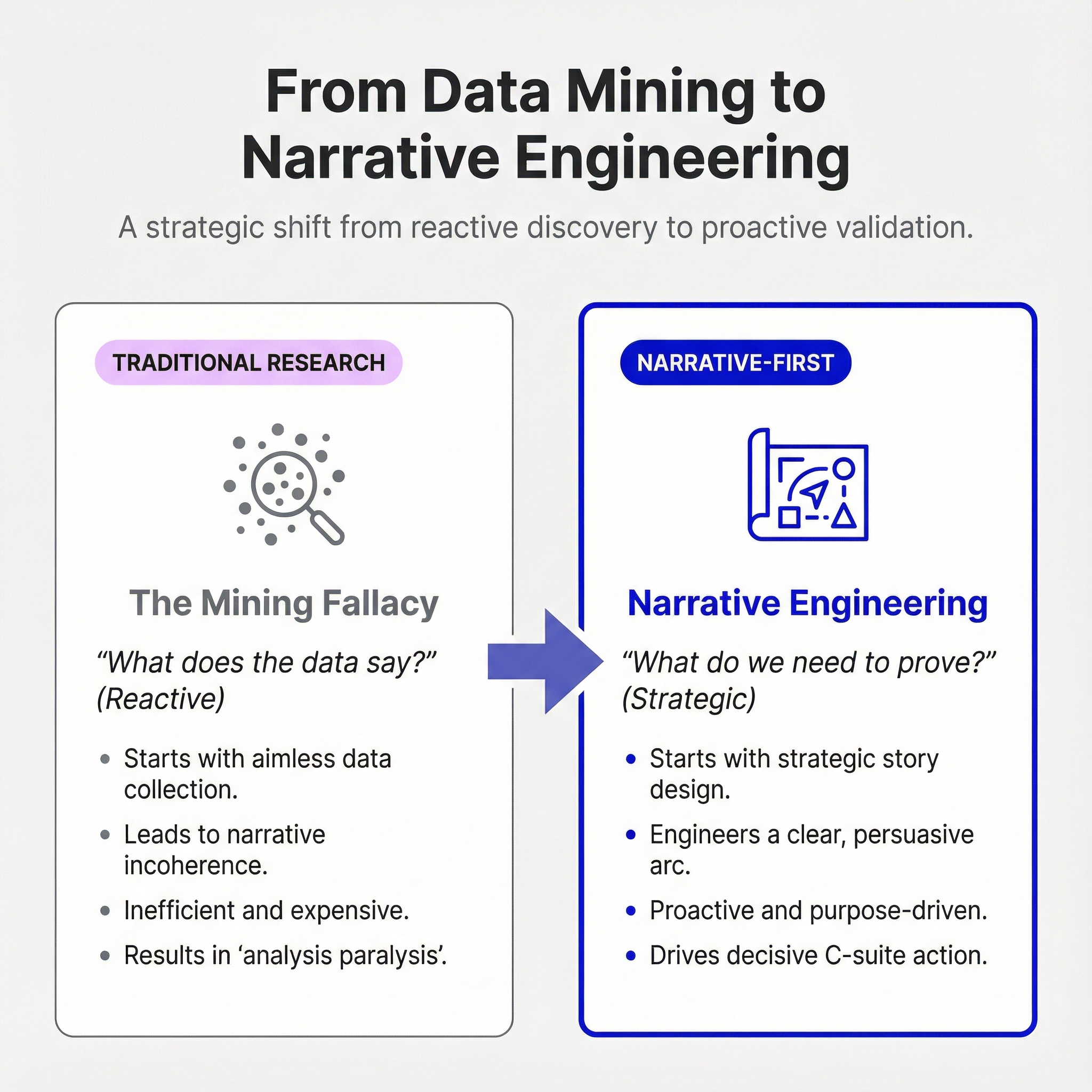
The “Mining for Insights” Fallacy: Why Traditional Research Fails
The standard research workflow—Collect, Analyze, Discover, Narrate—is broken.
It operates on the assumption that data is inherently valuable. It isn’t.
Data is noise until it is filtered through a strategic lens. When you let the data dictate the narrative, you end up with data narrative incoherence. This is a failure of logic where the audience cannot derive meaning from the statistics presented.
They see numbers. They don’t see a solution.
This leads to the “Data Paradox”: Leaders demand data-driven decision-making, yet when presented with raw data, they rely on gut instinct. Why? Because the data lacks the emotional context required to trigger a decision.
Research by Jennifer Aaker at Stanford Graduate School of Business suggests that stories are up to 22 times more memorable than facts alone.

If you are just presenting facts, you are statistically forgettable.
For a deeper look into the cognitive mechanics of how we process these visuals, review this research on research on the cognitive mechanics of data-driven decision making.
The High Cost of Random Data Exploration
Aimless data dredging is a budget killer.
When you engage in research without hypothesis, you are effectively walking into a library and reading random pages hoping to find a coherent novel.
You might find interesting facts. You might find that 42% of companies use 5+ marketing tools.
So what?
Unless that stat supports a specific business objective (like selling a consolidation platform), it is trivia. It is not thought leadership research.
Worse, random exploration leads to spurious correlations. You find patterns that exist by coincidence, not causation. In a business context, acting on these random signals isn’t just wasteful; it’s dangerous.
Psychological Safety: Why Incoherence Paralyzes Decisions
Your audience is looking for a guide, not a spreadsheet.
When a narrative is incoherent, it triggers a psychological response known as “Ineffective Coping.” The viewer cannot process the information structure, leading to anxiety and disengagement.
In the boardroom, we call this analysis paralysis.
A study by the National Center for Biotechnology Information found that individuals with coherent narratives reported higher levels of Purpose and Meaning.
Without that narrative coherence, your data feels unsafe. It feels risky. And risky data gets ignored.
When your research lacks a pre-defined narrative architecture, you aren’t just wasting budget—you are actively manufacturing ‘analysis paralysis’ for your prospects. Without the emotional bridge of a story, even the most rigorous data sets will be ignored by the C-suite in favor of intuition.
The Narrative-First Operating Model: Engineering the Story
Stop finding. Start creating.
This is Narrative Engineering. It is the discipline of architecting the conclusion before the investigation begins.
This is not about falsifying data. It is about Strategic Intent.
We define the “Process Control Narrative”—the exact sequence of beliefs we need to instill in the audience—and then we build the machinery to validate it.
According to Scott Hutcheson at Purdue University, technical expertise alone is insufficient for influence. Leaders must “design the story with the precision of an engineer.”
For those interested in agile frameworks for this type of planning, Purdue offers excellent frameworks for agile strategy and narrative guidance.
Phase 1: Strategic Discovery & Audience Architecture
Before we open a single spreadsheet, we design the argument.
We use the SCR framework (Situation, Complication, Resolution) combined with 5 Key Questions to build the audience architecture.
We ask: “What specific pain point is currently unsolvable for them?” and “What data point would make that pain undeniable?”
This is narrative first data strategy in action. We are drafting the blueprint of the house before we buy the bricks.
Phase 2: The “Selective Retrieval” Framework
Once the story is drafted, we know exactly what we need to prove.
This allows for selective retrieval. We don’t dump the entire database onto the slide. We filter for the specific data points that support the hypothesis.
This is where the “Data-Driven Coach” gets real with you: You will feel the urge to include everything.
Don’t.
If a data point does not advance the narrative arc, it is a distraction. Cut it.
Adopting an engineering mindset transforms storytelling from a creative afterthought into a repeatable operational discipline. By architecting the conclusion before the investigation, you ensure every data point collected serves a specific, high-value strategic purpose.
Targeted Data Creation: Manufacturing Strategic Proof
Now we have a wishlist. We know we need a stat that proves “X problem is costing companies Y dollars.”
But what if that data doesn’t exist?
We manufacture it.
This is Targeted Data Creation. We move from reactive collection to proactive generation.
Building the Internal “Idea Lab”
You need an engine for proprietary data.
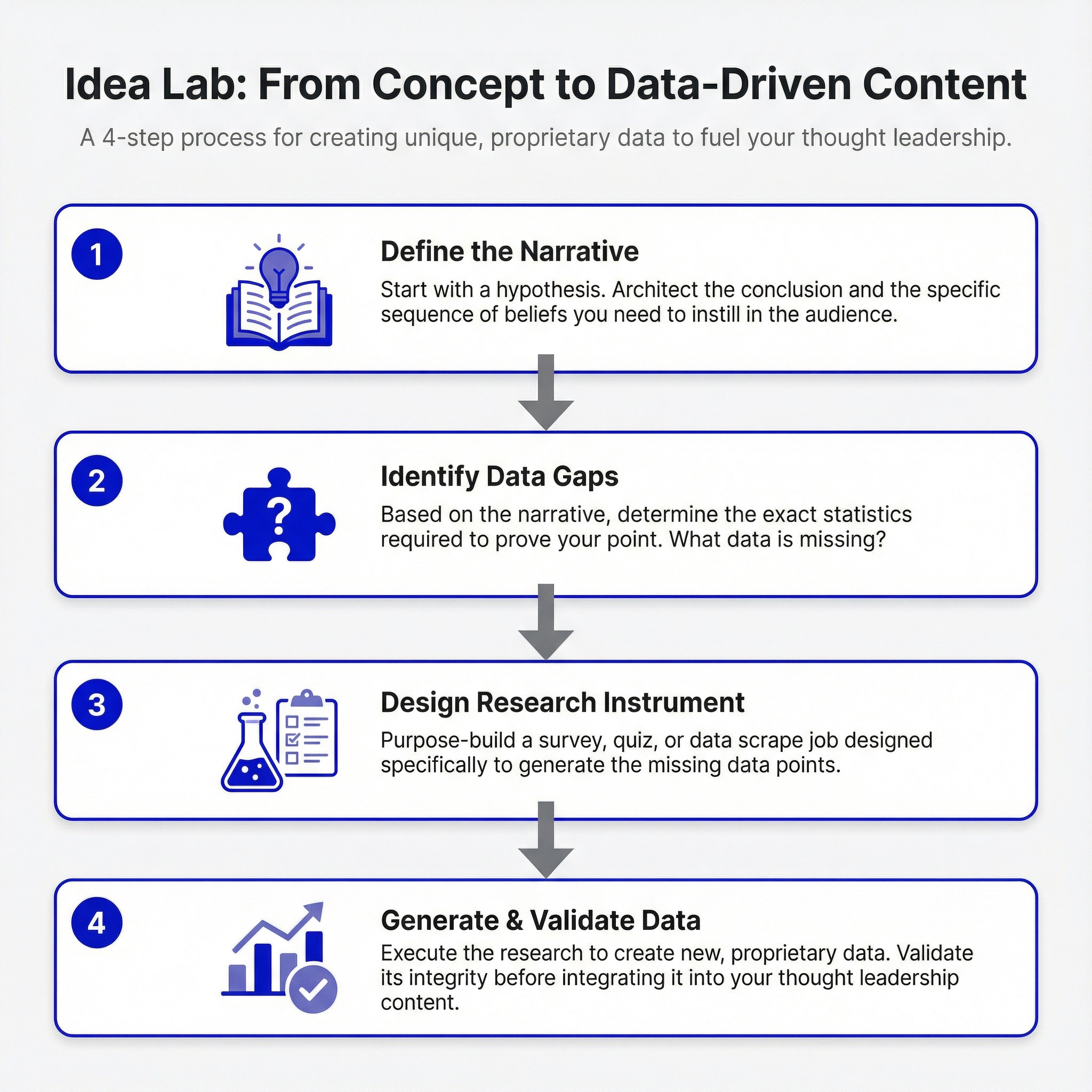
This is your internal “Idea Lab.” It’s an operating model where you design research instruments—surveys, quizzes, or scrape jobs—that are purpose-built to fill the gaps in your narrative.
If your story requires proving that “CMOs are burnt out,” you don’t wait for Gallup to publish a report. You launch a data driven thought leadership framework that polls 500 CMOs specifically on burnout metrics.
You own the question. You own the answer.
Synthetic Data & Retail Media Networks
The game is evolving.
We are seeing the rise of Targeted Data Generation (TDG) using AI. Recent research in the ACL Anthology shows that targeted generation can improve model performance by 2-13% for specific subgroups.
Marketers can use similar principles. Retail Media Networks allow us to access granular, privacy-compliant audience signals that act as proxies for deep behavioral truths.
We can use synthetic data generation to model scenarios that haven’t happened yet, providing “predictive proof” for our narratives.
The difference between a generic blog post and a market-moving white paper is often the exclusivity of the data supporting it. When you manufacture your own proof through targeted creation, you build a competitive moat that rivals cannot cross simply by subscribing to the same third-party tools.
Beyond Surveys: AI, RAG, and Structured Narrative States
This isn’t just about better blog posts. It’s about surviving the AI shift.
If you feed an AI raw, unstructured text, it hallucinates. It makes things up.
Why? Because it lacks context.
A narrative-first approach forces you to organize your data into Structured Narrative States or Knowledge Graphs.

A 2024 study by Muqtadir et al. on Mitigating Hallucinations found that integrating structured Knowledge Graphs reduced AI hallucination rates from 22% to 5%.
By structuring your content as a data-backed narrative, you are optimizing it for Retrieval-Augmented Generation (RAG).
For a technical deep-dive on this, review the IEEE Computer Society’s work on mitigating hallucinations in retrieval-augmented generation models.
As we transition to AI-driven search and content generation, the structural integrity of your data becomes as important as its accuracy. Organizations that fail to organize their data into structured narrative states risk feeding their customers AI hallucinations, while those who do will dominate the era of retrieval-augmented generation.
Governance & Ethics: The Strategic Data Validation Framework
We are engineering the story, but we are not fiction writers.
There is a fine line between narrative engineering and manipulation. That line is Strategic Data Validation.
You must implement automated checks for referential integrity.
This is your safety valve.
If you hypothesize that “Sales are down because of X,” and your targeted data creation proves that sales are actually up, you must pivot.
Strategic data collection for content requires the discipline to kill a great story if the data refuses to validate it.
Refer to NIST’s standards for identifying and managing data bias to build your governance checklist.
Engineering a story does not grant license to fabricate the truth; it demands a higher standard of validation to ensure your narrative holds up under scrutiny. A robust governance framework protects your brand’s reputation, ensuring that your engineered insights are reproducible, accurate, and ethically sound.
Conclusion
Stop asking, “What does the data say?”
That is a passive, reactive question. It surrenders your strategy to the whims of a spreadsheet.
Start asking, “What do we need to prove?”
That is the question of a market leader.
The Narrative-First Data Strategy is the only way to build proprietary assets in a noisy world. It requires you to be an architect first and an analyst second.
It requires effort. It requires a shift in mindset. But the result is content that doesn’t just inform—it influences.
Ready to stop mining for insights and start engineering authority? Contact our strategy team to build your Narrative-First Data Operating Model today.
Frequently Asked Questions
Is “Narrative-First” just confirmation bias?
No, it is “Hypothesis-Driven.” In science and business, you form a hypothesis first, then test it. If the data disproves your narrative, you pivot. The error is not in having a narrative, but in ignoring data that contradicts it.
How does this differ from standard Data Storytelling?
Standard Data Storytelling is reactive—it focuses on visualizing data you already have. Narrative-First Data Strategy is proactive—it focuses on creating the specific data you need to tell the story you want to own.
What is Targeted Data Creation?
Targeted Data Creation involves using surveys, synthetic data generation, or behavioral tracking to generating new, proprietary data points specifically designed to fill gaps in your strategic narrative.
How does this help with AI and RAG?
AI models (like LLMs) struggle with unstructured text. By organizing your data into “Structured Narrative States” (Knowledge Graphs), you provide the context AI needs to retrieve accurate information, significantly reducing hallucinations.
References
- Aaker, Jennifer. “Harnessing the Power of Stories.” Stanford Graduate School of Business. Source
- Hutcheson, Scott. “Narrative Engineering: Transforming Complex Ideas into Compelling Stories.” Purdue University. Source
- Muqtadir, et al. “Mitigating Hallucinations Using Ensemble of Knowledge Graph and Vector Store in Large Language Models.” ArXiv (Cornell University), 2024. Source
- National Center for Biotechnology Information. “Psychological effects of narrative coherence.” Source
- ACL Anthology. “Targeted Data Generation for AI.” Source


