
Welcome to the global arena of packaging, where the rules of engagement are constantly shifting, and the stakes for non-compliance are higher than ever. If you’re a global business, a supply chain manager, a sustainability officer, or part of a legal and compliance team, you know the drill: the fragmented, dynamic, and often contradictory nature of international packaging laws is not just a headache; it’s a significant barrier to uninterrupted international business growth. You’re trying to navigate a labyrinth of mandates, from the EU’s sweeping PPWR to the patchwork of US state-level PCR content laws and the myriad of single-use plastic bans emerging worldwide. The risks are real—hefty penalties, supply chain disruptions, and irreversible brand damage.
But here’s the truth: this isn’t just about avoiding trouble. It’s about transforming a daunting challenge into a strategic advantage. This article isn’t just another overview; it’s your definitive strategic blueprint for mastering global packaging regulations. We’ll decode the fragmented laws, detail the most sought-after solutions, and provide a future-proof framework for compliance and sustainable practices. Consider this your playbook for operational efficiency, risk mitigation, and unwavering brand integrity in a complex world. We’ll cover the evolving regulatory landscape, dive deep into critical mandates like Extended Producer Responsibility (EPR) and Post-Consumer Recycled (PCR) content, confront the complexities of multi-jurisdictional compliance, and arm you with strategic approaches and technological solutions to ensure not just survival, but thriving growth.

Key Takeaways
- Global packaging regulations are increasingly fragmented and dynamic, requiring proactive monitoring and adaptation.
- Extended Producer Responsibility (EPR) schemes and mandatory Post-Consumer Recycled (PCR) content targets are critical global trends.
- Non-compliance carries significant financial penalties and reputational risks for international businesses.
- Leveraging specialized packaging regulation databases and compliance software is essential for managing multi-jurisdictional adherence.
- A strategic blueprint involves balancing global standardization with local regulatory nuances and fostering continuous compliance.
- Future-proofing operations through sustainable packaging design and robust compliance programs ensures uninterrupted international business growth.
Table of Contents
The Evolving Global Landscape of Packaging Regulations: Trends & Mandates
The world of packaging regulations is in constant flux, driven by an undeniable global push towards sustainability and aggressive waste reduction targets. What was once a relatively straightforward matter of safety and labeling has morphed into a complex web of environmental mandates, making global packaging regulations one of the most challenging areas for international businesses. This isn’t just a trend; it’s a fundamental shift, demanding a proactive approach to avoid the pitfalls of complex packaging regulations.
Consider the sheer scale of this evolution. From the comprehensive directives emanating from the European Union to the diverse, state-specific initiatives across the United States, and the rapidly developing frameworks in Asia and Latin America, the regulatory landscape is a mosaic of varying requirements. According to market intelligence from GlobalData, the focus is squarely on reducing packaging waste, increasing recyclability, and promoting the use of recycled content. This global momentum means that companies operating across the top 50 economies packaging laws must contend with an ever-growing list of obligations. Navigating these diverse packaging laws across regions, as highlighted by Trayak, requires not just diligence but a strategic overhaul of traditional compliance methods. As researchers Thapliyal et al. note in their academic review, the regulatory framework for sustainable food packaging materials alone spans continents, underscoring the fragmented nature of these laws.
Decoding the EU’s Packaging and Packaging Waste Regulation (PPWR)
At the forefront of this regulatory evolution is the European Union’s Packaging and Packaging Waste Regulation (PPWR). This isn’t merely an update; it’s a foundational legislative document, officially known as Regulation (EU) 2025/40 of the European Parliament and of the Council. Starting in 2025, the PPWR aims to establish rules covering the entire life-cycle of packaging, harmonizing national measures, and significantly reducing the environmental impact of packaging waste.
The PPWR sets ambitious targets: a 5% reduction in packaging waste by 2030, 10% by 2035, and a substantial 15% by 2040. Crucially, it mandates a 20% reduction in plastic packaging by 2040. These objectives are deeply rooted in the EU’s “waste hierarchy”, as outlined in Directive 2008/98/EC, prioritizing prevention, reuse, and high-quality recycling. For any international business, understanding EU PPWR is paramount, as its influence extends far beyond Europe’s borders, setting a precedent for packaging recyclability standards and recycled content targets that global players must consider.
US State-Level Mandates: PCR Content & Single-Use Plastic Bans
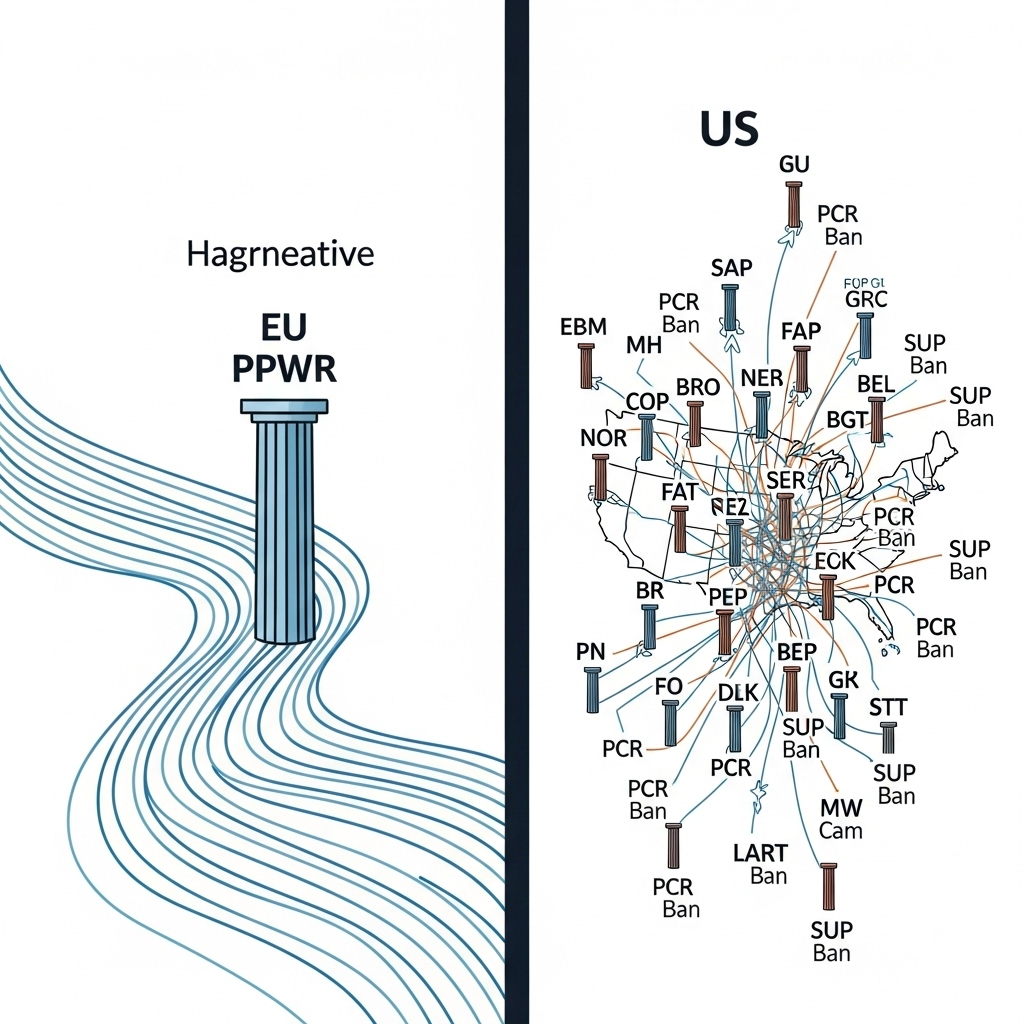
While the EU drives harmonization, the United States presents a different challenge: a highly fragmented landscape of varying recycling laws. Rather than a singular federal mandate, US state PCR content laws and single-use plastic bans US are proliferating, creating a complex compliance puzzle.
The Association of Plastic Recyclers (APR) reports that as of August 2024, five US states have passed laws requiring post-consumer recycled content in plastic packaging. These state-level initiatives, such as those in California or New York, often include specific percentages for PCR content, varying by plastic type and product category. This patchwork approach means that a product compliant in one state might fall short in another. For businesses, this inconsistency necessitates meticulous tracking and often, a regionalized approach to packaging design and material sourcing. You can find more details on these US State Packaging Regulatory Updates.
Emerging Regulatory Frameworks in Asia & Latin America
The regulatory wave isn’t confined to Europe and North America. Asia and Latin America are rapidly developing their own stringent frameworks to tackle plastic waste and promote sustainability. This includes a growing adoption of Extended Producer Responsibility (EPR) schemes and specific mandates for recycled content and single-use plastic reduction.
In Latin America, a notable example is Peru’s Law 30884, which mandates that plastic bottles contain a minimum of 15% recycled materials. This is a clear signal of the region’s commitment to circular economy principles. Meanwhile, in Asia, countries like China, the world’s largest population and second-largest economy, are implementing comprehensive plastic policies, including bans and restrictions on various plastic products. India’s India EPR guidelines are also evolving, pushing producers to take greater responsibility for their packaging waste. Beyond these, countries like Canada, with its SUPPR aiming for zero plastic waste by 2030, and Australia, aligning with its 2025 National Packaging Targets, are also demonstrating significant regulatory shifts. These diverse and rapidly changing Asia packaging laws and Latin America packaging regulations underscore the global imperative to manage plastic waste effectively.
The dynamic and fragmented nature of global packaging regulations means businesses can no longer rely on static compliance strategies; instead, they must cultivate agile systems and a culture of continuous monitoring to avoid costly penalties and maintain market access.
Navigating Extended Producer Responsibility (EPR) & Recycled Content Requirements
If the evolving landscape is the challenge, then Extended Producer Responsibility (EPR) and mandatory recycled content requirements are the two colossal mountains you must climb. These aren’t just regulatory hurdles; they are fundamental shifts that redefine how products are designed, materials are sourced, and operational costs are managed. For any business striving for packaging compliance and facing global compliance challenges, mastering these two areas is non-negotiable.
The Association of Plastic Recyclers (APR) emphasizes that these trends are often intertwined: five US states, for instance, have EPR laws in place that not only aim to increase collection but also include recycled content incentives or goals, creating a powerful supply and demand dynamic for recycled materials. Organizations like Plastics Recycling and the APR Design Guide are critical resources in understanding how to navigate these complex requirements and design for optimal recyclability.
Global EPR Schemes: Variations and Compliance Obligations
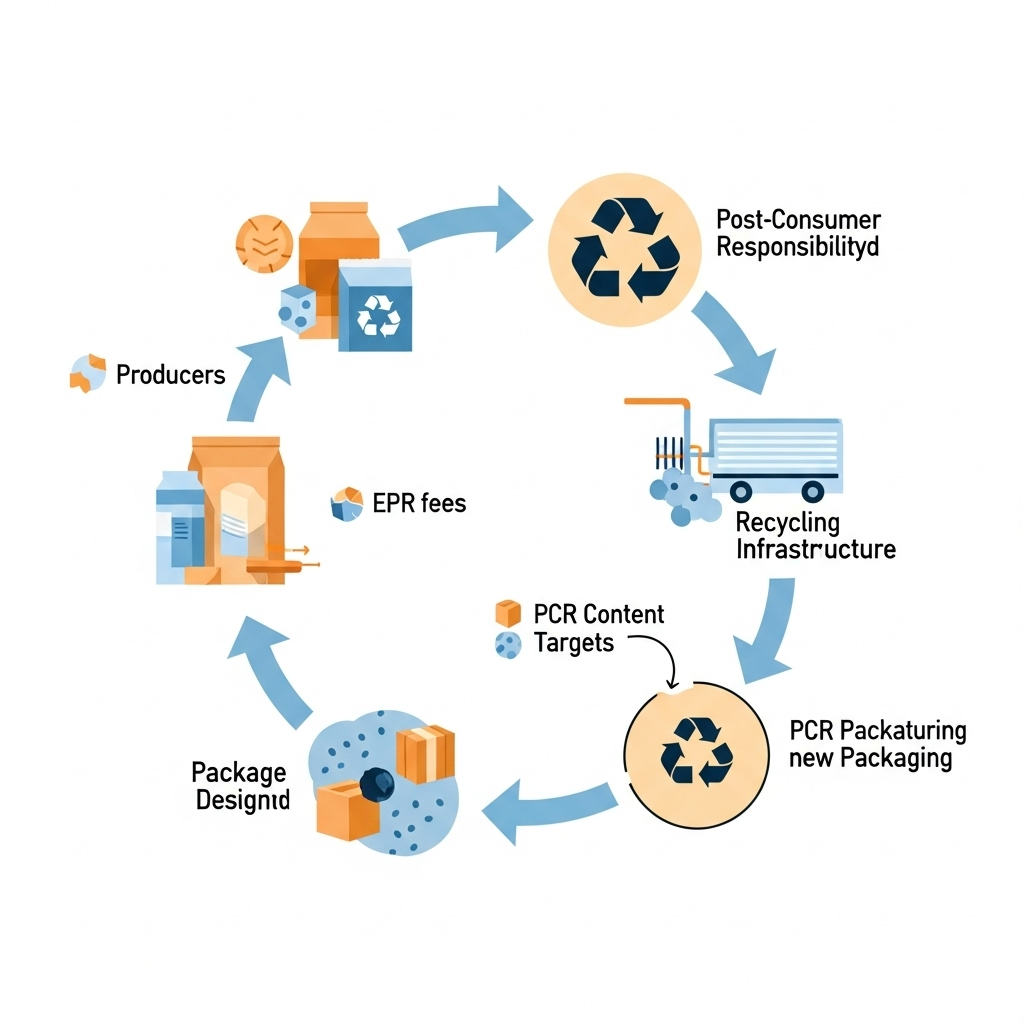
At its core, Extended Producer Responsibility (EPR) is a policy approach where producers are held responsible for the entire lifecycle of their products and packaging, from design to post-consumer waste management. This means shifting the financial and/or physical burden of waste management from municipalities and taxpayers to the companies that introduce products into the market.
However, the devil is in the details—and the details vary wildly. Global EPR schemes are implemented through diverse models: some countries have centralized systems with standardized fees, while others feature competitive, multi-scheme environments. Compliance obligations can include mandatory registration, detailed reporting of packaging placed on the market (by material type and weight), payment of fees based on these reports, and participation in collection and recycling targets. For a comprehensive overview, the Sustainable Packaging Coalition’s (SPC) guide on EPR is an invaluable resource. Furthermore, the Ellen MacArthur Foundation provides strategic insights into EPR within the broader context of a Global Plastics Treaty, highlighting how these schemes are fundamental to transitioning to a circular economy and effective packaging waste management.
Mandatory Recycled Content: Meeting Diverse Targets
Beyond EPR, the push for plastic recycling laws is manifesting in increasingly stringent mandatory recycled content requirements. This trend aims to create robust demand for recycled materials, driving investment in recycling infrastructure and closing the loop on packaging waste.
Countries and regions are setting diverse post-consumer recycled content targets (PCR) for various packaging types, particularly plastics. For example, as noted earlier, Peru’s Law 30884 specifically requires plastic bottles to contain 15% recycled materials. These mandates present significant challenges for businesses, from ensuring consistent supply of high-quality recycled materials to adapting manufacturing processes. The technical hurdles in recycled materials sourcing and integration are considerable, often requiring innovation in packaging design and material science. The APR Design Guide, for instance, helps companies design packaging that is compatible with existing recycling infrastructure, a critical step in meeting these mandates.
The proliferation of EPR schemes and recycled content mandates transforms packaging from a cost center into a strategic lever, compelling businesses to fundamentally rethink product design and supply chain partnerships to meet evolving sustainability goals and avoid significant financial burdens.
Strategic Compliance & Future-Proofing Your Global Packaging Operations
In this era of dynamic and fragmented regulations, simply reacting to new laws is a recipe for disaster. To truly master the landscape and ensure uninterrupted international business growth, you need a proactive, strategic approach to packaging compliance. This involves leveraging cutting-edge tools, building resilient internal programs, and adopting a flexible international business strategy that balances global efficiency with local adherence. The goal isn’t just to avoid penalties; it’s to transform regulatory challenges into a competitive advantage.
The scale of the challenge demands sophisticated solutions. Consider McKinsey’s Sustainable Packaging Hub, which features a database spanning 57 countries and over 20 packaging substrates, demonstrating the sheer volume of data involved. Similarly, Trayak’s EcoImpact-COMPASS LCA software includes a regularly updated database, vital for real-time compliance. For businesses dealing with vast product portfolios, Rev-Log’s packaging database, which holds over 50 million SKUs with access plans starting at less than $1,000, illustrates the specialized tools available. As compliance experts like TMF Group emphasize, continuous monitoring and addressing compliance gaps are paramount. This isn’t a “checkbox exercise” but a strategic imperative, as TrustCloud points out, to mitigate global compliance challenges and protect brand integrity.
Leveraging Packaging Regulation Databases & Compliance Software
If Rocky Balboa was a content marketer, his montage wouldn’t include punching meat, one-handed pushups, and running up the 72 steps of the Philadelphia Museum of Art. No, some Philly Soul would accompany him writing SQL queries, wrangling multimillion-row CSV files, and working out how to rotate axis labels in D3. The modern compliance manager’s training montage involves mastering an international packaging regulation database. These specialized tools are no longer a luxury; they are indispensable for tracking, managing, and reporting on the intricate web of global packaging regulations.
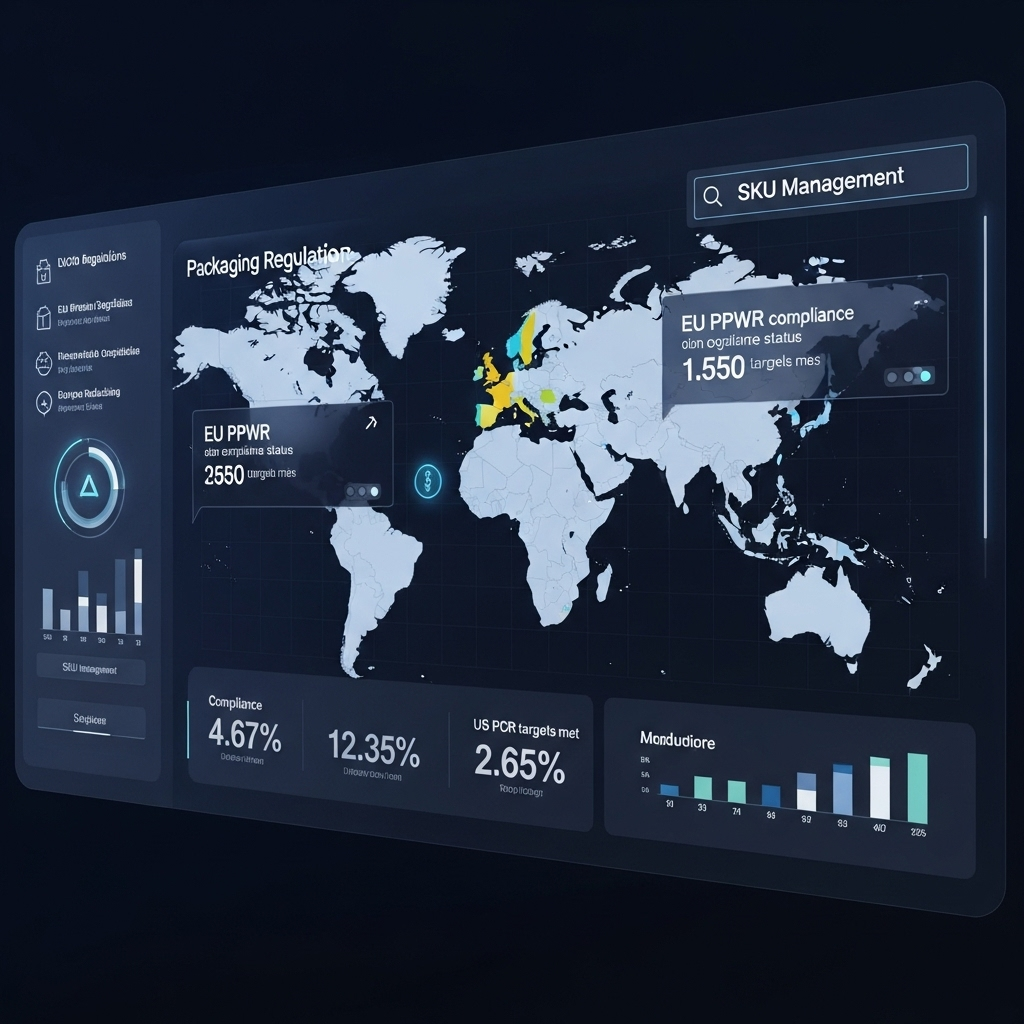
When evaluating a packaging regulation database features, look for comprehensive geographical coverage, real-time legislative updates, and robust SKU management packaging capabilities. Solutions like YNP Global’s database, Trayak’s EcoImpact-COMPASS LCA, and Reconomy’s Comply Loop offer critical functionalities such as recyclability assessment and multi-jurisdictional reporting. The benefits of automation and streamlining compliance processes for accurate packaging data, especially for EPR reporting, are immense, reducing manual errors and freeing up valuable resources.
Building a Resilient Global Compliance Program
A robust, proactive global compliance framework for packaging is your shield against legal repercussions and reputational damage. This isn’t a one-time setup; it’s a commitment to continuous compliance. Key components include:
- Proactive Risk Assessment: Regularly identify and evaluate potential compliance risks across all operating jurisdictions.
- Internal Expertise Development: Invest in training and education for your teams, ensuring they understand the nuances of packaging regulations relevant to their roles. As FoodChain ID and Paramount Global emphasize, knowledgeable staff are your first line of defense.
- Cross-Functional Collaboration: Break down silos. Compliance isn’t just a legal department’s job; it involves R&D, supply chain, marketing, and sales.
- Technology Integration: Implement integrated risk management (IRM) software that connects various compliance data points and provides a holistic view of your global adherence. This helps in effective risk mitigation packaging.
This comprehensive approach moves beyond mere adherence to fostering a culture where compliance is ingrained in every operational decision.
Balancing Global Strategy with Local Regulatory Nuances
The ultimate strategic challenge for multinational corporations is balancing global standardization packaging with the absolute necessity of local adaptation packaging. While global brands strive for efficiency through uniform packaging designs and centralized supply chains, the reality of diverse regulations demands flexibility.
This is where the concepts of “global integration” and “local responsiveness” come into play, as discussed by Norwich University Online. A truly effective international business strategy involves a “blueprint” for strategy development, as suggested by Masson International, that allows for strategic deviations based on local regulatory mandates. For example, a company like L’Oréal, aiming for 100% recyclable or reusable packaging by 2030, must navigate this balance, ensuring their global sustainability goals align with the specific requirements of each market. This might mean different material choices, labeling, or collection schemes for the same product in different regions. Successful market entry strategies depend on this nuanced understanding and the agility to adapt without compromising brand identity or operational efficiency.
Strategic investment in global compliance solutions transforms regulatory burdens into a competitive advantage, enabling businesses to expand confidently into new markets and ensure uninterrupted growth by proactively managing risks and demonstrating unwavering commitment to sustainability.
Conclusion
The journey through the intricate world of global packaging regulations is undoubtedly complex, but it is far from insurmountable. We’ve traversed the dynamic landscape, from the ambitious mandates of the EU’s PPWR to the fragmented yet impactful state-level laws in the US and the emerging frameworks across Asia and Latin America. The imperative of Extended Producer Responsibility (EPR) and mandatory Post-Consumer Recycled (PCR) content is clear: these are not optional add-ons but fundamental shifts demanding strategic attention.
Your ability to thrive in this environment hinges on a proactive, data-driven approach. By leveraging specialized packaging regulation databases and compliance software, building resilient global compliance programs, and skillfully balancing global standardization with local regulatory nuances, you can transform potential liabilities into drivers of growth. This isn’t just about avoiding penalties; it’s about fostering sustainable practices that enhance brand reputation, ensure market access, and ultimately, secure your position as a leader in the international business arena. Mastering global packaging regulations is not merely compliance; it’s a strategic pathway to uninterrupted growth and a future-proof operation.
For tailored strategies and in-depth consultation on your specific global packaging compliance requirements, contact our expert team today.
This article provides general information and does not constitute legal or regulatory advice. Businesses should consult with qualified legal and compliance professionals for specific guidance related to their operations and jurisdictions.
Frequently Asked Questions
What are the key global trends in packaging regulations?
Key global trends include a strong push towards sustainability, waste reduction targets, increased mandatory recycled content requirements, the widespread adoption of Extended Producer Responsibility (EPR) schemes, and bans on single-use plastics. Regulations are becoming more fragmented and dynamic, requiring continuous monitoring.
How do EU packaging regulations (e.g., PPWR) impact international businesses?
The EU’s Packaging and Packaging Waste Regulation (PPWR) significantly impacts international businesses by setting stringent targets for packaging reduction, recyclability, recycled content, and reusability. Companies exporting to or operating within the EU must comply with these harmonized rules, influencing packaging design, material choices, and supply chain operations globally.
Which US states have mandatory post-consumer recycled (PCR) content laws for plastic packaging?
As of August 2024, five US states have passed laws requiring post-consumer recycled (PCR) content in plastic packaging. These laws vary by state regarding specific percentages, plastic types, and implementation timelines, adding complexity for businesses operating nationwide.
How do Extended Producer Responsibility (EPR) schemes work for plastic recycling?
EPR schemes hold producers financially and/or physically responsible for the end-of-life management of their packaging. For plastic recycling, this means producers often pay fees into a system that funds collection, sorting, and recycling infrastructure. Many EPR laws also include recycled content incentives or goals to drive demand for recycled materials.
What are the key features to look for in an international packaging regulation database?
An effective international packaging regulation database should offer comprehensive geographical coverage (e.g., top 50 economies), real-time legislative updates, SKU-level management, recyclability assessment tools, multi-jurisdictional reporting capabilities, and support for EPR compliance. Look for databases that are regularly updated and backed by expert teams.
Why are packaging regulations becoming increasingly complex?
Packaging regulations are becoming complex due to a global push for environmental sustainability, varying national and regional priorities, the rapid evolution of packaging materials and technologies, and the fragmented nature of legislative bodies. This leads to a patchwork of often contradictory laws across different jurisdictions, making compliance challenging for international businesses.
References
- Association of Plastic Recyclers (APR). “Recycled Plastic Content Requirements.” Plastics Recycling, https://plasticsrecycling.org/tools-and-resources/policy-hub/policy-priorities/recycled-plastic-content-requirements/. Accessed 14 Aug. 2025.
- Association of Plastic Recyclers (APR). “APR Design Guide for Plastics Recyclability.” Plastics Recycling, https://plasticsrecycling.org/apr-design-guide. Accessed 14 Aug. 2025.
- adaPETation®. “Global Plastic Regulations.” adapetation.net, https://adapetation.net/global-plastic-regulations/. Accessed 14 Aug. 2025.
- Aranca. “Recent Packaging Regulations and its Impact on the Industry.” Aranca Knowledge Library, https://www.aranca.com/knowledge-library/articles/business-research/recent-packaging-regulations-and-its-impact-on-the-industry”. Accessed 14 Aug. 2025.
- ELAW. “Plastic.” ELAW.org, https://elaw.org/plastic. Accessed 14 Aug. 2025.
- Ellen MacArthur Foundation. “Extended Producer Responsibility (EPR) Briefing Paper.” content.ellenmacarthurfoundation.org, https://content.ellenmacarthurfoundation.org/m/68555566f2a217b8/original/Business-Coalition-for-a-Global-Plastics-Treaty-Extended-Producer-Responsibilty-Briefing-Paper.pdf. Accessed 14 Aug. 2025.
- European Parliament and of the Council. “Regulation (EU) 2025/40 of the European Parliament and of the Council of 19 December 2024 on packaging and packaging waste…” EUR-Lex, https://eur-lex.europa.eu/eli/reg/2025/40/oj/eng. Accessed 14 Aug. 2025.
- European Parliament and of the Council. “Directive 2008/98/EC of the European Parliament and of the Council of 19 November 2008 on waste…” EUR-Lex, https://eur-lex.europa.eu/legal-content/EN/TXT/?uri=CELEX%3A32008L0098. Accessed 14 Aug. 2025.
- FoodChain ID. “Essential Guide to Packaging Compliance and Sustainability.” FoodChainID.com, https://www.foodchainid.com/resources/essential-guide-to-packaging-compliance-and-sustainability-answering-your-top-questions/. Accessed 14 Aug. 2025.
- GlobalData. “Global packaging regulations: tracking new laws across key markets.” Packaging Gateway, https://www.packaging-gateway.com/news/global-packaging-regulations-tracking-new-laws-across-key-markets/. Accessed 14 Aug. 2025.
- L’Oréal. “Our Commitments for 2030.” Loreal.com, https://www.loreal.com/en/sustainability/for-the-future/our-commitments-for-2030/”. Accessed 14 Aug. 2025.
- Masson International. “International Business Strategy: The Ultimate Guide for Global Success.” MassonInternational.com, https://www.massoninternational.com/blog/international-business-strategy-the-ultimate-guide-for-global-success”. Accessed 14 Aug. 2025.
- McKinsey & Company. “Sustainable Packaging Hub.” McKinsey.com, https://www.mckinsey.com/industries/packaging-and-paper/how-we-help-clients/sustainable-packaging-hub”. Accessed 14 Aug. 2025.
- Norwich University Online. “International Business Strategies in a Globalizing World.” online.norwich.edu, https://online.norwich.edu/international-business-strategies-globalizing-world”. Accessed 14 Aug. 2025.
- Paramount Global. “Stay Ahead of Packaging Regulations.” ParamountGlobal.com, https://www.paramountglobal.com/knowledge/stay-ahead-packaging-regulations/”. Accessed 14 Aug. 2025.
- Plastics Recycling. “Policy Hub.” PlasticsRecycling.org, https://plasticsrecycling.org/tools-and-resources/policy-hub”. Accessed 14 Aug. 2025.
- Reconomy. “EPR for Packaging.” Reconomy.com, https://www.reconomy.com/extended-producer-responsibility/epr-for-packaging/”. Accessed 14 Aug. 2025.
- Rev-Log. “EPR Laws for Packaging in the United States: Where Are We Now?” Rev-Log.com, https://rev-log.com/us/epr-laws-for-packaging-in-the-united-states-where-are-we-now/”. Accessed 14 Aug. 2025.
- Sustainable Packaging Coalition. “Understanding Extended Producer Responsibility (EPR).” EPR.SustainablePackaging.org, https://epr.sustainablepackaging.org/”. Accessed 14 Aug. 2025.
- Thapliyal, Devyani, Manisha Karale, and Vaibhav Diwan. “Current Status of Sustainable Food Packaging Regulations: Global Perspective.” MDPI, vol. 16, no. 13, 2024, p. 5554. https://www.mdpi.com/2071-1050/16/13/5554″. Accessed 14 Aug. 2025.
- TMF Group. “Global compliance challenges and business complexity.” TMF-Group.com, https://www.tmf-group.com/en/news-insights/articles/global-business-complexity/global-compliance-challenges-business-complexity/”. Accessed 14 Aug. 2025.
- Trayak. “Navigating Packaging Laws in 10 Regions Worldwide.” Trayak.com, https://trayak.com/navigating-packaging-laws-in-10-regions-worldwide/”. Accessed 14 Aug. 2025.
- TrustCloud. “Global Compliance Challenges in 2024: A Comprehensive Guide for Businesses.” community.trustcloud.ai, https://community.trustcloud.ai/docs/grc-launchpad/grc-101/compliance/global-compliance-challenges-in-2024-a-comprehensive-guide-for-businesses/”. Accessed 14 Aug. 2025.
- YNP Global. “Global Packaging Regulation Database.” YNPGlobal.com, https://ynpglobal.com/global-packaging-regulation-database/”. Accessed 14 Aug. 2025.


