
Key Takeaways
- Revenue-Centric SEO must replace volume-based strategies, focusing on reducing Customer Acquisition Cost (CAC) and generating SQLs rather than vanity traffic.
- Technical Authority Governance adapts engineering rigor to content creation, using SME review boards to solve the ‘trust deficit’ among technical buyers.
- The ‘Ghost-Lie-Truth’ framework is essential for engaging skeptical technical audiences by addressing misconceptions with data-backed engineering reality.
- High-Intent Technical SEO targets specific error codes, API endpoints, and ‘feature flags’ to capture solution-aware developers at the moment of need.
- A ‘Marathon Content Strategy’ is required to nurture prospects through the 6-18 month ‘Dark Funnel’ typical of B2B SaaS sales cycles.
- Agile Execution aligns content velocity with product release cycles, treating content updates with the same version control discipline as software code.
You are likely suffering from Effort Shock.
You have published hundreds of blog posts. You have optimized thousands of meta tags. Your traffic graph looks like the Himalayas.
But your demo requests? Flatline.
This is the Vanity Metric Trap.
In the B2B SaaS world, particularly when selling to technical decision-makers like CTOs and VPs of Engineering, “content marketing” is often a dirty word. It implies fluff. It implies a lack of rigor. It implies that you are trying to trick them into a funnel rather than help them solve a complex engineering problem.
If Rocky Balboa was a content marketer, his montage wouldn’t include punching meat or running up the 72 steps of the Philadelphia Museum of Art. No, some Philly Soul would accompany him writing SQL queries, wrangling multimillion-row CSV files, and auditing API documentation.
Because data is data. And for the technical buyer, data is the only language that matters.
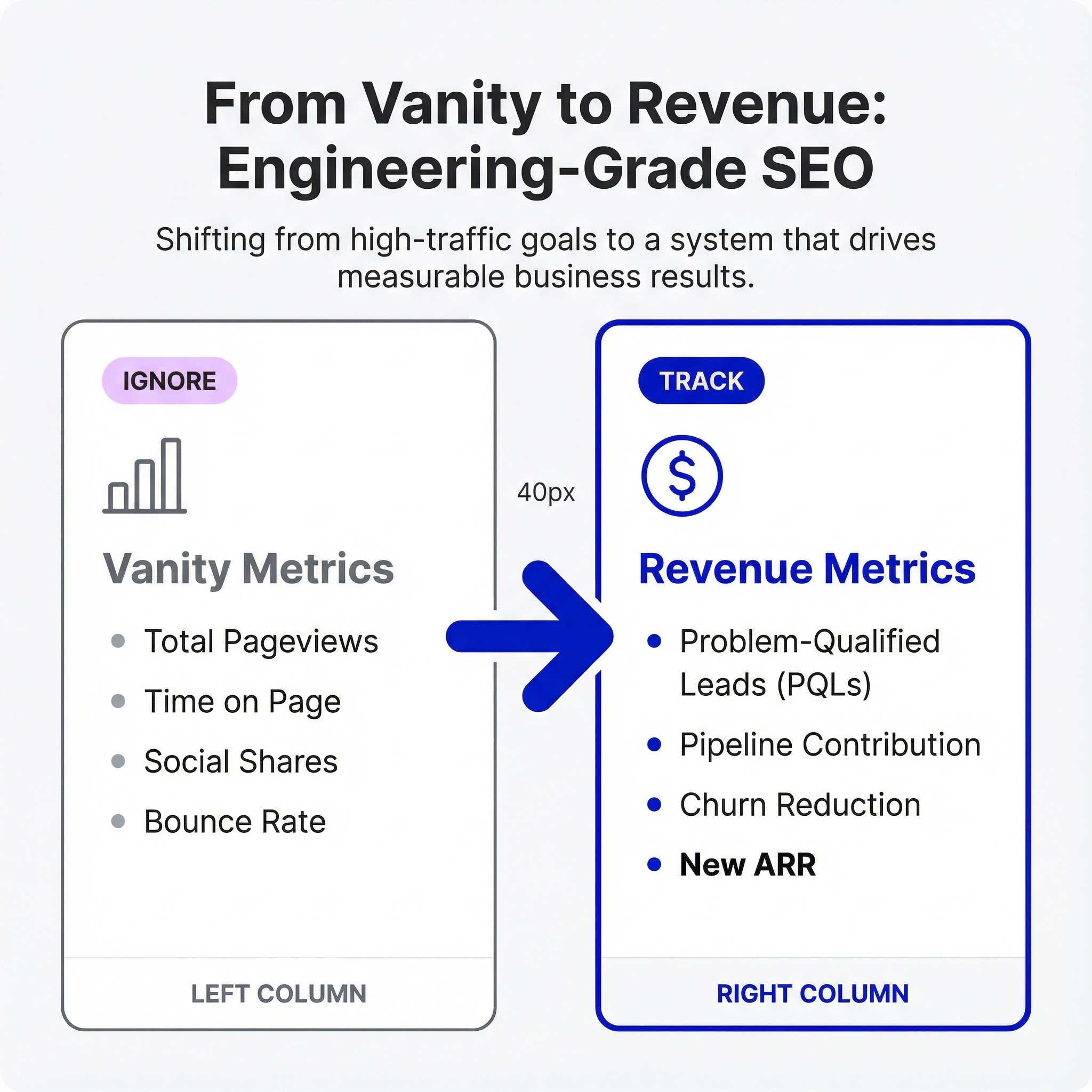
At GrowVerge, we realized that the traditional agency model—”post and pray”—is dead on arrival for long-cycle SaaS. The solution isn’t more content. It is better engineering.
We call this the Authority & Acquisition System.
It is an engineering-grade framework that treats content with the same discipline as your software code. It shifts the focus from “attracting visitors” to reducing Customer Acquisition Cost (CAC) and generating Problem-Qualified Leads (PQLs).
This is your playbook for building it.
The Crisis of Generic SEO in B2B SaaS
Most SEO advice is written for e-commerce or local plumbers. It assumes a linear path: Search → Click → Buy.
In B2B SaaS, the journey is a labyrinth.
According to benchmarks from Dreamdata, the average B2B customer journey stretches over 192 days and involves 62 touches. That is six months of scrutiny before a contract is even signed.
Generic SEO fails here because it optimizes for the click, not the six-month relationship.
The ‘Trust Deficit’ with Technical Buyers
The technical buyer is a unique beast. They possess a built-in “BS Detector” calibrated to detect marketing fluff at a molecular level.
If you promise “seamless integration” without showing the API docs, they leave. If you claim “AI-driven insights” without explaining the training data, they bounce.
Recent analysis of the Stack Overflow Developer Survey confirms this skepticism: while 76% of developers use AI tools, 79% are concerned about misinformation.
They do not trust you.
To bridge this gap, you must pivot from “Persuasive Copy” to Evidence-Based Content.
Marketing Copy vs. Engineering Documentation
The distinction is stark.
- Marketing Copy: Focuses on benefits, uses adjectives (“revolutionary,” “seamless”), and hides complexity.
- Engineering Documentation: Focuses on capabilities, uses nouns (“JSON,” “Latency”), and exposes complexity.
To win, your top-of-funnel content must feel like the latter. It must include metrics that matter to an engineer: uptime, EBITDA impact, and latency speeds.
Navigating the ‘Dark Funnel’ of Long Sales Cycles
Your analytics dashboard is lying to you.
It shows you the “Last Click” attribution, but it misses the iceberg beneath the surface—the Dark Funnel. This is where your prospect is doing research in private Slack communities, on Reddit, and in offline peer conversations.
In a 6-18 month sales cycle, silence is not failure. It is simply the “Evaluation” phase.
At GrowVerge, we focus on capturing Problem-Qualified Leads (PQLs)—users who have identified a specific technical pain point and are using your content to scope the solution.
If your content stops being useful after the first click, you lose them during the dark months. You need assets that sit on their desktop for weeks.
Implications: The Cost of Shallow Content
Ignoring the sophistication of technical buyers results in high bounce rates and burned brand equity; conversely, respecting their intelligence with data-heavy content builds the foundational trust required for six-figure deals.
Phase 1: The ‘Research Once’ Protocol & Technical Intelligence
Stop guessing.
Most content teams brainstorm topics in a conference room. This is a waste of time. Your customers have already told you what they want; you just aren’t listening.
We utilize a “Research Once, Create Many” principle. We perform a deep-dive technical audit one time to build a massive repository of intelligence, which then fuels 6-12 months of content.
To execute this, we use tools like DataForSEO and FireCrawl to scrape and analyze the entire competitive landscape. We don’t just look at keywords; we look at the semantic structure of the market.
High-Intent Technical Keyword Research
Forget “high volume.” You want “high agony.”
A developer searching for “best database software” (Volume: 10,000) is browsing. A developer searching for “Error 503 upstream connect Kubernetes” (Volume: 50) is bleeding.
That is your customer.
We structure our research around three specific technical pillars:
- Error Code SEO: Systematically creating pages that solve the specific error codes your competitor’s product generates.
- Integration SEO: Ranking for queries related to how your tool connects with their existing stack (e.g., “Terraform state file management”).
- Feature-Flag SEO: Optimizing for features that are currently in beta or highly requested in the market.
The GrowVerge Matrix
When we onboard a client, we use a custom Asana template to build a multi-layer keyword matrix. We cross-reference “Pain Point” terms with “Competitor” terms.
We then mine GitHub Issues and Stack Overflow threads. If 50 developers are asking about a specific library conflict, that is not a forum post. That is a blog post title.
The Market Intelligence Report: A Single Source of Truth
Data without synthesis is noise.
We aggregate our findings into a central Market Intelligence Report. This is the bible for your content team.
We use our proprietary Topical Authority Engine, built in NocoDB, to cluster thousands of keywords into semantic groups. We then run these insights through our n8n Custom Feedback Analyzer, which processes sales call transcripts and support tickets to identify the exact language customers use.
This report ensures alignment. Sales knows what Marketing is saying. Product knows what Sales is promising.
Implications: The Intelligence Layer
Without a centralized intelligence layer, content teams guess at topics and dilute authority; with it, every piece of content becomes a strategic asset that directly addresses a validated market pain point.
Phase 2: The Technical Authority Governance Model
This is the most critical differentiator in our framework.
You must stop treating content production like a creative writing class. You must treat it like a software release.
We adapt the NASA Technical Authority model for SaaS content. In engineering, a “Technical Authority” has the power to stop a launch if safety standards aren’t met. In marketing, you need a similar veto power for accuracy.
As the Google Developer Documentation Style Guide famously mandates: “Treat documentation like code.”
Operationalizing the SME Review Board
At GrowVerge, we implement a Technical Authority Governance protocol for our clients.
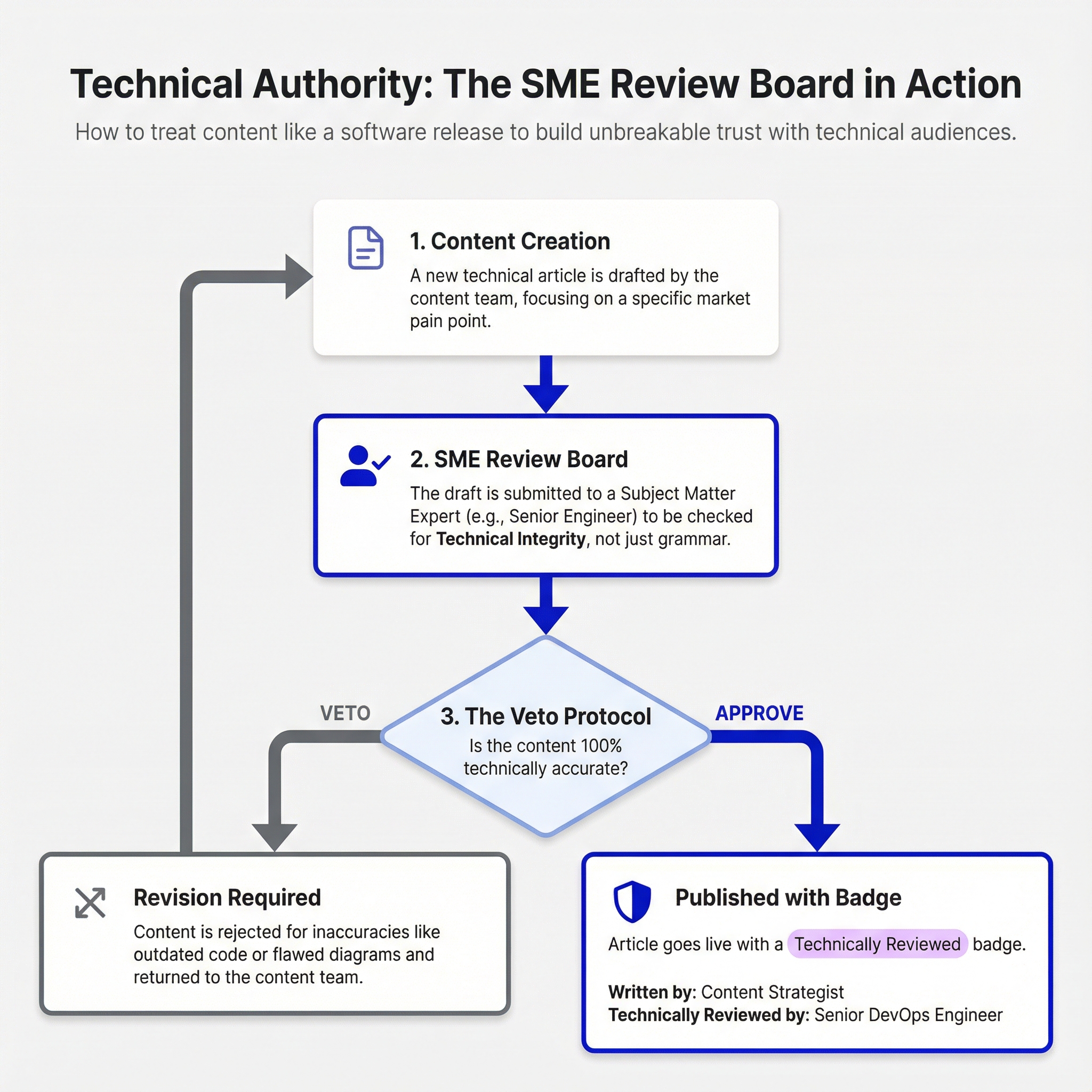
This involves establishing an SME (Subject Matter Expert) Review Board.
The Veto Power Protocol
Marketing does not get the final say. An engineer does.
Before any piece of technical content goes live, it must be reviewed by a designated SME (e.g., a Senior DevOps Engineer or Product Architect). They are not checking for grammar; they are checking for Technical Integrity.
If the code snippet is outdated? Veto.
If the architectural diagram is simplified to the point of being wrong? Veto.
The Technical Integrity Badge
Once a piece passes this review, it earns a badge.
We explicitly include bylines on the article:
- Written by: [Content Strategist]
- Technically Reviewed by: [Name], Senior DevOps Engineer
This simple signal kills the “Trust Deficit.” It tells the reader, “A peer reviewed this. It is safe to use.”
To ensure the baseline quality of the site itself, we also run a Website Quality Audit SOP to fix redirects, schema errors, and Core Web Vitals, ensuring the vessel is as strong as the cargo.
Implications: Engineering-Grade Trust
Adopting an engineering-grade review process eliminates the ‘marketing fluff’ that repels developers, effectively turning your blog into a trusted extension of your product documentation.
Phase 3: Production via the ‘Ghost-Lie-Truth’ Engine
Now that you have the data and the governance, you need the narrative.
Data alone is dry. You need to wrap it in a story that resonates with the engineering mindset. We use a proprietary storytelling framework called Ghost-Lie-Truth.
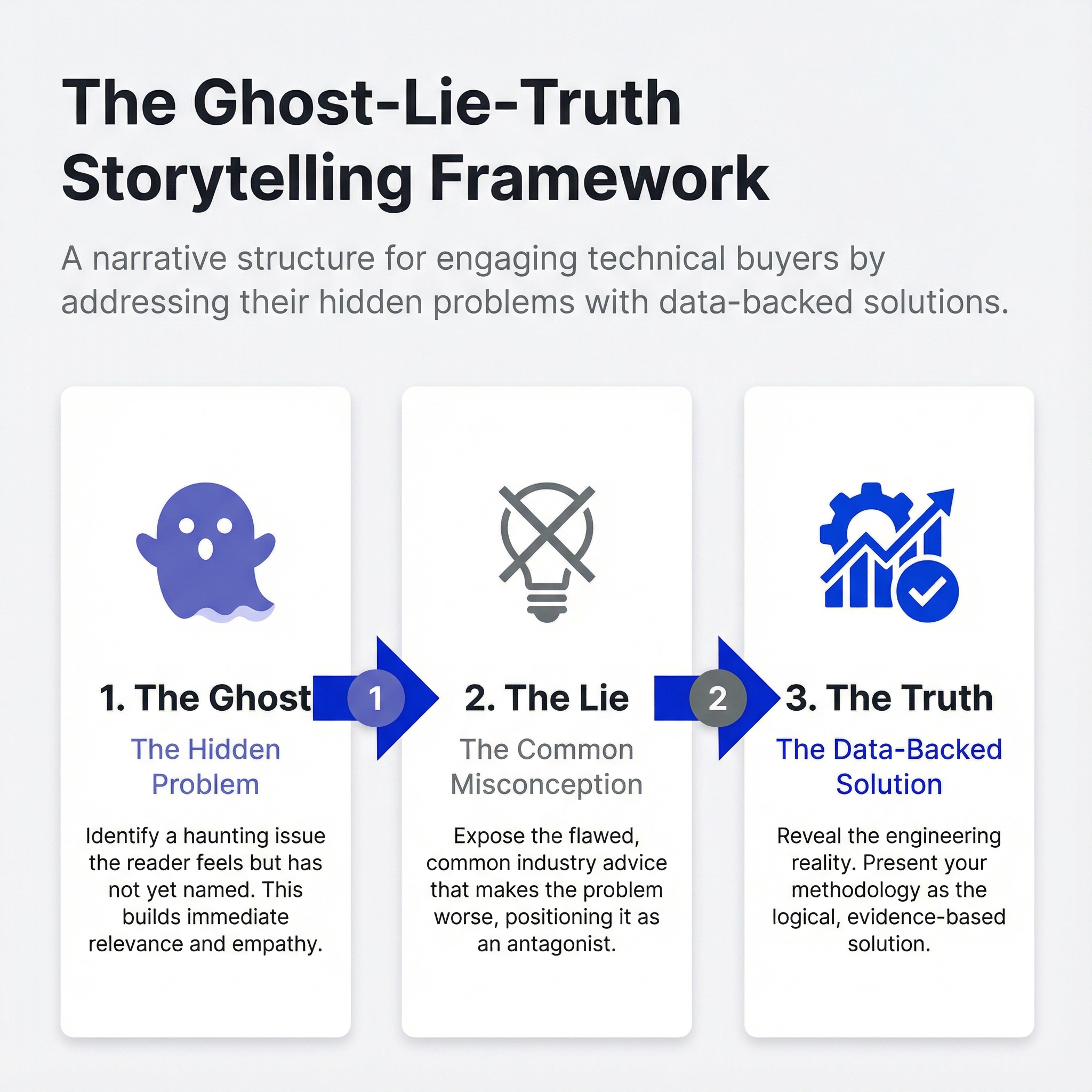
- The Ghost (The Hidden Problem): Identify a haunting issue the reader feels but hasn’t named (e.g., “Why your cloud bill doubles every six months”).
- The Lie (The Misconception): Expose the common industry advice that is actually making it worse (e.g., “Just buy more reserved instances”).
- The Truth (The Data-Backed Solution): Reveal the engineering reality, supported by your product’s methodology (e.g., “You need automated container rightsizing”).
We use our In-Depth Article Engine, powered by Tavily and Perplexity, to ensure the “Truth” section is packed with verifiable external citations and deep research.
The ‘Sandwich Technique’ for Dual Audiences
B2B SaaS has a “Two-Headed Buyer.”
- The User (Dev/Engineer): Cares about how it works.
- The Buyer (CTO/CFO): Cares about ROI and security.
You cannot write two separate blogs. You must use the Sandwich Technique.
The Top Bun (Business Value): Start with the high-level implication. “Reducing latency by 50ms improves conversion by 1%.” (For the CTO).
The Meat (Technical Specs): Dive deep. Show the JSON. Show the config file. Explain the load balancing algorithm. (For the Developer).
The Bottom Bun (Implementation/ROI): detailed roadmap of how to roll this out and what the financial upside is. (For both).
This structure allows us to create “Magnum Opus” content—flagship pieces that serve as the definitive guide for an entire industry topic.
Implications: Narrative Structure
Using a structured narrative framework prevents technical content from becoming dry manuals; it transforms complex features into compelling business arguments that empower internal champions to sell for you.
Phase 4: ‘Marathon’ Distribution & Conversion
You hit publish. Now what?
In a “post and pray” world, you share it on LinkedIn once and move on. In the Marathon Content Strategy, the publication is just the starting line.
The 18-Week Implementation Plan
We utilize a Gantt-style 18-week implementation plan for every major content asset.
This includes:
- The Serial Guest Post Technique: We don’t just ask for links. We write “Spin-off” articles for authoritative industry publications that reference our Magnum Opus as the source data.
- News-Hook Personalization: We monitor industry news. When a relevant event happens (e.g., a major AWS outage), we re-promote our “Redundancy Planning” guide with a fresh intro tying it to the news.
Nurturing PQLs with Mental Models
The goal is to move visitors into the Problem-Qualified Lead (PQL) bucket.
Once they opt-in, we don’t spam them with “Book a Demo” emails. We place them into a “Welcome & Deep Value” sequence.
We deliver “Mental Model as a Service.”
Instead of product updates, we send newsletters that teach them how to think about the problem. “How to think about API rate limiting” is infinitely more valuable than “New rate limiting features.”
This keeps your brand top-of-mind during the 192-day sales cycle. You become the steady hand guiding them through the dark funnel.
Implications: The Steady Presence
In a 12-month sales cycle, silence is fatal; a marathon distribution strategy ensures your brand remains the ‘Steady Presence’ that guides the prospect from curiosity to contract.
Measuring Revenue, Not Just Traffic
If you report “Organic Sessions” to your Board of Directors, you deserve to lose your budget.
Traffic is vanity. Revenue is sanity.
At GrowVerge, we use a Content-Strategy Scorecard that ignores the fluff. We track:
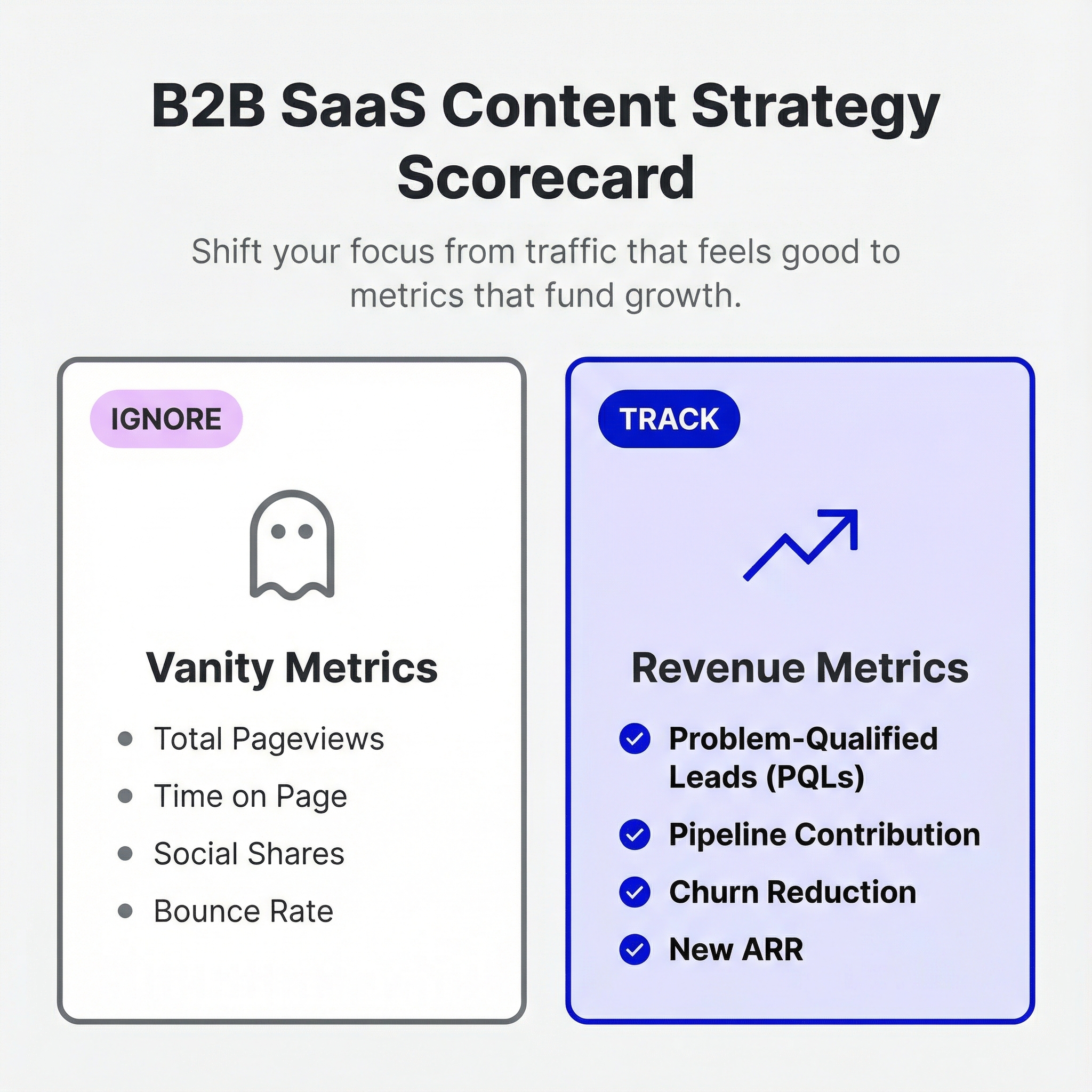
| Vanity Metric (Ignore) | Revenue Metric (Track) | Why It Matters |
|---|---|---|
| Total Pageviews | Problem-Qualified Leads (PQLs) | Measures intent, not just eyeballs. |
| Time on Page | Pipeline Contribution | Did this article touch a deal that closed? |
| Social Shares | Churn Reduction | Did this support doc prevent a cancellation? |
| Bounce Rate | New ARR | The only number the CFO cares about. |
We also look closely at Churn Reduction. High-quality “Support SEO” content—docs that help users fix their own problems—directly correlates with higher Customer Lifetime Value (LTV).
Referencing standard financial principles for calculating marketing return on investment (ROI), we ensure that every content dollar can be tied to a booked meeting or a retained dollar.
Implications: Securing Budget
When you align SEO metrics with the CFO’s dashboard, marketing transforms from a cost center into a predictable revenue engine, securing long-term budget and buy-in.
Conclusion
The era of “content marketing” is over. We have entered the era of Technical Authority.
In the complex world of B2B SaaS, the winner is not the company with the loudest blog. It is the company with the most rigorous engineering culture—applied to their words as strictly as their product.
You must research deeper. You must govern harder. You must measure better.
This is not just about ranking #1 on Google. It is about proving to a skeptical, intelligent buyer that you are the only adults in the room capable of solving their problem.
Stop writing fluff. Start building authority.
Ready to build your own Authority & Acquisition System? Contact GrowVerge today to implement our Engineering-Grade SEO Framework and turn your technical expertise into a predictable revenue engine.
Frequently Asked Questions
How does B2B SaaS SEO differ from traditional SEO?
B2B SaaS SEO focuses on high-intent, low-volume queries that drive revenue (MQLs/SQLs) rather than high-volume traffic. It requires deep technical authority and content designed for long sales cycles (6-18 months) involving multiple decision-makers.
What is a Technical Authority Framework in content?
It is a governance model adapted from engineering (like NASA’s) where Subject Matter Experts (SMEs) have veto power over content accuracy. This ensures all marketing material is technically precise, building trust with developer audiences.
How do you measure the ROI of technical content?
Instead of vanity metrics like pageviews, measure ROI through Problem-Qualified Leads (PQLs), Booked Meetings, Pipeline Contribution, CAC Reduction, and expansion revenue (LTV) from existing clients.
What is the Ghost-Lie-Truth storytelling framework?
It is a narrative structure that engages technical buyers by first identifying a hidden problem (Ghost), exposing a common industry misconception (Lie), and then presenting the data-backed engineering solution (Truth).
How can content help reduce SaaS churn?
By producing high-quality “Support SEO” content—such as detailed documentation, error code fixes, and implementation guides—you help users solve problems quickly, increasing product adoption and satisfaction.
References
- Dreamdata. (2024). B2B Go-to-Market Benchmarks 2024.
- Stack Overflow. (2024). Attribution as the Foundation of Developer Trust.
- Google. (n.d.). Google Developer Documentation Style Guide.
- Harvard Business School Online. (n.d.). A Guide to Calculating Return on Investment (ROI).


