
Are you an HR leader or business executive grappling with the seemingly impossible task of finding qualified talent? Do you look at your overflowing applicant pools, only to find a frustrating scarcity of truly suitable candidates? If so, you’re not alone. The modern labor market is in the throes of a profound “hiring crisis,” but it’s not just a shortage; it’s a systemic mismatch, fueled by outdated job requirements that artificially narrow your talent pool.
This isn’t just about finding warm bodies; it’s about the insidious creep of “credential inflation” and “degree creep,” phenomena that devalue genuine experience and non-traditional learning pathways. It’s a paradox where the pursuit of higher education, while often beneficial, can ironically limit opportunities for skilled individuals who don’t fit the traditional mold.
But here’s the good news: there’s a definitive playbook to navigate this treacherous terrain. This guide will empower you to unlock the future of talent acquisition by mastering skills-based hiring. We’ll expose the problem, detail its far-reaching impacts, build an unassailable business case for change, and provide the practical, step-by-step blueprint you need to build a resilient, diverse, and future-ready workforce. Get ready to transform your talent strategy from a reactive struggle to a proactive, competitive advantage.
- The Credential Paradox: Understanding Credential Inflation and Degree Creep
- Navigating the Global Talent Mismatch: Why Traditional Hiring Fails
- The Business Imperative: Why Skills-Based Hiring is the Solution
- Implementing Skills-Based Recruitment: A Practical Blueprint
- Future-Proofing Your Workforce: Beyond the Hire
The Credential Paradox: Understanding Credential Inflation and Degree Creep
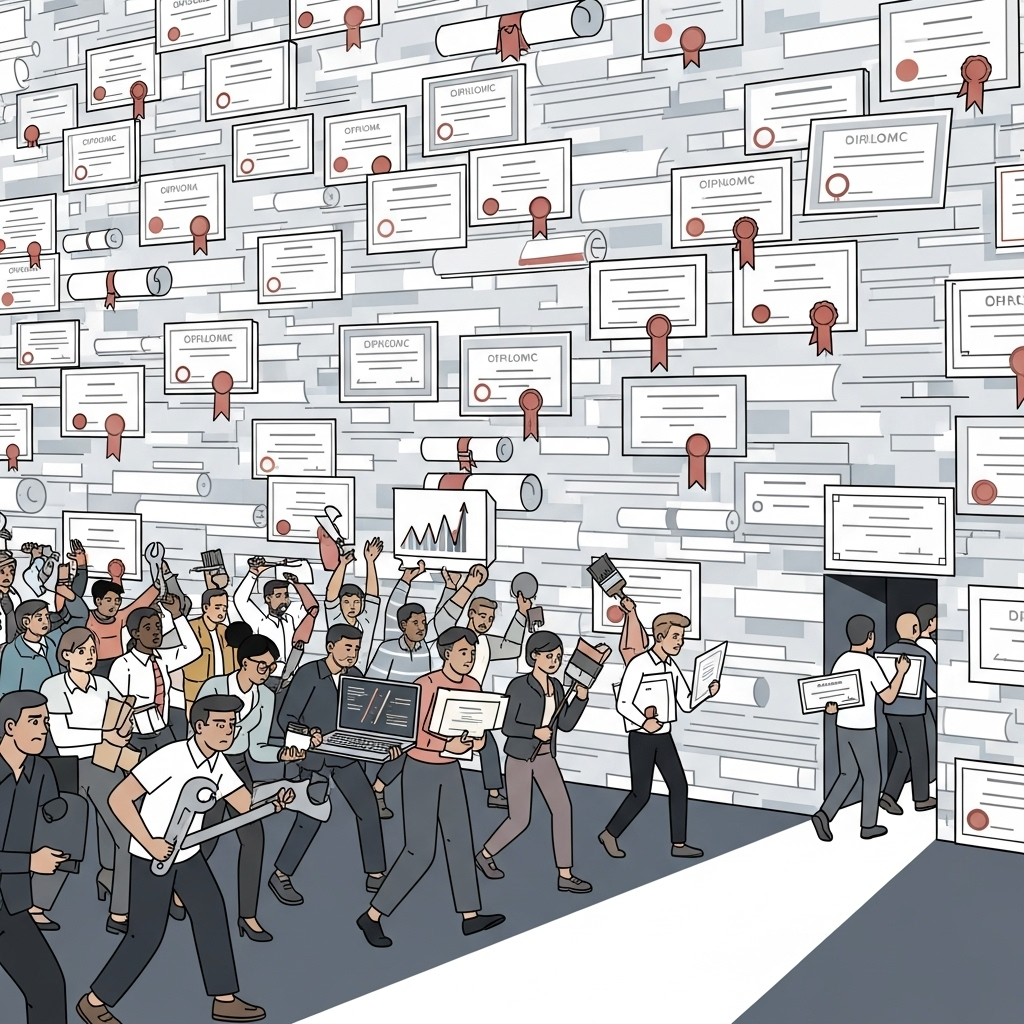
If Rocky Balboa was a content marketer, his montage wouldn’t include punching meat, one-handed pushups, and running up the 72 steps of the Philadelphia Museum of Art. No, some Philly Soul would accompany him writing SQL queries, wrangling multimillion-row CSV files, and working out how to rotate axis labels in D3. And if he were a hiring manager, his struggle would be less about physical endurance and more about the invisible barriers of “credential inflation” and “degree creep.” These aren’t just academic terms; they’re economic forces reshaping the very fabric of our labor market, often stifling the very talent you desperately need.
Defining the Problem: Credential Inflation vs. Degree Creep
Let’s cut through the jargon. Credential inflation is the broader phenomenon where the value of educational degrees diminishes over time due to an oversupply of graduates. This leads employers to demand higher and higher credentials for roles that historically didn’t require them. It’s like a currency devaluation, but for diplomas. Degree creep, on the other hand, is a specific, insidious manifestation of this trend: the expansion of degree requirements into jobs where they are not functionally necessary [2].
Think of it this way: Credential inflation is the rising tide, and degree creep is the water seeping into every crack, demanding a four-year degree for roles that could be capably handled by someone with vocational training, demonstrable skills, or substantial experience. For instance, the role of a Wienermobile spokesperson, once a quirky entry-level position, now often lists a bachelor’s degree as a requirement [5]. This creates a “degree gap,” where the qualifications demanded by employers exceed those held by a significant portion of the current workforce in those very roles [4].
Root Causes: Why Unnecessary Requirements Persist
So, why does this happen? Why do employers cling to these seemingly arbitrary requirements? It’s not always malicious; often, it’s a mix of historical inertia, risk aversion, and a reliance on degrees as a convenient proxy for skills. In a competitive hiring landscape, a degree becomes a quick filter, a perceived signal of diligence, intelligence, and trainability.
Economically, it’s a classic supply and demand problem. As more people pursue higher education, the supply of degreed candidates increases. This, in turn, can devalue existing degrees and push employers to demand even higher credentials to differentiate candidates, creating a feedback loop [6]. Policy analysts like Andrew Gillen highlight that employers often use degrees to reduce hiring risk, even when the degree itself doesn’t directly correlate with job performance [3]. It’s a shortcut, but one that comes at a significant cost.
The Far-Reaching Impacts on Job Seekers and the Economy
The consequences of this credential paradox are profound, affecting both individuals and the broader economy. For job seekers, especially those without traditional four-year degrees, it means limited opportunities and the devaluation of their practical experience and non-formal learning. This is particularly stark for underrepresented groups: in the United States, only 26% of Black Americans and 18% of LatinX people over age 25 have four-year college degrees, compared to 58% of Asian Americans and 40% of non-Hispanic white people [11]. Arbitrary degree requirements thus perpetuate systemic inequities.
The psychological toll is also significant. Individuals feel pressured to pursue costly degrees, often accumulating substantial student debt, even when their chosen career path might not genuinely require one. This can lead to feelings of being “overqualified” for available jobs, a frustrating scenario where highly skilled individuals are overlooked due to employer concerns about retention and engagement [8]. As career counselors often advise, candidates must strategically articulate their value and commitment to overcome this perception [10], [9].
Economically, credential inflation leads to a massive underutilization of talent. Joseph Fuller’s team at Harvard Business School found that across the U.S. economy, an estimated 6.2 million workers could be losing out on job opportunities due to credential inflation alone [1]. This isn’t just a number; it’s lost productivity, stifled innovation, and a significant drag on economic growth.
Implication: Credentialism stifles talent.
The pervasive nature of credential inflation and degree creep creates artificial barriers, leading to a significant underutilization of skilled talent and exacerbating the global hiring crisis.
Navigating the Global Talent Mismatch: Why Traditional Hiring Fails
We’re not just facing a “hiring crisis“; we’re wrestling with a fundamental talent mismatch. It’s like trying to fit a square peg in a round hole, repeatedly, while complaining about a shortage of square holes. Traditional hiring models, built on the bedrock of credentialism, are failing to connect with the available talent pool, leading to massive inefficiencies and missed opportunities.

Consider the landscape: 62% of business leaders and HR professionals rated finding and keeping qualified employees as their top business challenge in 2024 [12]. In the finance sector, 40% of job openings are going unfilled. And IDC predicts that more than 90% of organizations worldwide will experience an IT skills crisis by next year, potentially translating to a staggering $5.5 trillion in lost productivity [13]. This isn’t a minor headache; it’s a full-blown economic migraine.
The Core of the Crisis: More Than Just a Shortage
The modern talent challenge isn’t simply a lack of people; it’s a profound misalignment. Economic shifts, demographic changes (like the unexpected 16% year-over-year decline in new hiring for recent college graduates in 2025 [18]), and rapidly evolving skill demands have created a chasm between what businesses need and what traditional resumes present. It’s a skills-degree mismatch, where individuals’ actual competencies don’t align with outdated job requirements [14].
The OECD reports that skill mismatch affects around two out of five employees in its member countries, with an average mismatch of 31.7% [14]. This isn’t just an abstract statistic; it translates to an estimated global economic toll of 6% annual tax due to lost labor productivity, as highlighted by BCG [15]. This isn’t a talent shortage; it’s a talent misallocation fueled by an outdated system.
The Cost of Misaligned Requirements: Productivity and Diversity
Poorly defined or unnecessary job requirements are the silent saboteurs of your hiring process. They don’t just make it harder to find candidates; they actively exclude diverse and highly qualified talent. For instance, while job requirements define the essential skills and qualifications, and job responsibilities outline daily tasks [16], many companies conflate the two, or worse, add superfluous demands.
This leads to significant productivity losses and higher turnover because you’re either missing out on the best fit or hiring someone who quickly becomes disengaged. The importance of clear, relevant job requirements cannot be overstated [20]. A thorough job analysis is crucial for identifying truly essential requirements and avoiding discriminatory practices that inadvertently screen out capable individuals [16].
Overcoming the ‘Overqualified’ Dilemma
Another symptom of this mismatch is the “overqualified” dilemma. Employers often hesitate to hire candidates with too much experience or education, fearing they’ll quickly become bored, demand higher salaries, or leave for a more challenging role [8]. But this perspective is fundamentally flawed. Instead of “overqualified,” think “untapped potential.”
These individuals often bring a wealth of experience, advanced skills, and a broader perspective that can be invaluable. The trick is for employers to recognize and leverage this talent, and for candidates to strategically articulate their value proposition and demonstrate long-term commitment. This might involve tailoring resumes to focus on relevant skills, proactively addressing concerns about engagement during interviews, and even discussing a willingness to accept a salary commensurate with the role, not necessarily their highest previous earning [10], [9]. It’s about finding the right fit, not just the right degree.
Implication: Outdated hiring models perpetuate talent gaps.
Traditional, credential-centric hiring processes exacerbate the talent crisis by creating a significant skill-degree mismatch, leading to economic inefficiencies and missed opportunities for both employers and job seekers.
The Business Imperative: Why Skills-Based Hiring is the Solution
Alright, enough with the problem statement. Let’s talk solutions. If the current hiring landscape feels like trying to bail out a sinking ship with a thimble, then skills-based hiring is your industrial-strength pump. This isn’t just a buzzword; it’s a strategic imperative that delivers tangible, measurable value, boosting your bottom line and future-proofing your workforce.
The shift is already underway. The number of employers adopting skills-based hiring surged from 57% in 2022 to a remarkable 81% in 2024 [21]. Why the rapid acceleration? Because it works.
For firms that truly embrace it, it yields significant results: non-degreed workers hired into roles that formerly required degrees showed a retention rate 10 percentage points higher than their degree-holding colleagues, and they experienced a 25 percent salary increase on average [1]. This isn’t just about being fair; it’s about being smart.
This approach isn’t merely about “credential rightsizing” – though that’s a crucial component [2]. It’s about a fundamental re-evaluation of how you identify, assess, and develop talent. As policy analysts like Andrew Gillen have noted, a tight job market is forcing employers to prioritize job skills over degrees, driving this necessary shift [3].

Enhanced Diversity and Inclusion
One of the most immediate and impactful benefits of skills-based hiring is its profound effect on diversity and inclusion. By removing arbitrary degree barriers, you naturally broaden your talent pool. Remember the statistics on degree attainment for Black and LatinX individuals [11]? When you focus on demonstrable skills rather than a piece of paper, you open doors to highly capable professionals who might have gained their expertise through vocational training, bootcamps, military service, or extensive on-the-job experience. This isn’t just about ticking a box; diverse teams are proven to be more innovative, adaptable, and ultimately, more profitable.
Improved Efficiency and Candidate Fit
When you hire for skills, you’re hiring for what truly matters: a candidate’s ability to perform the job. This leads to more accurate candidate assessments and a better fit for the role. Competency-based recruitment, which evaluates candidates based on inherent skills and behavioral traits [22], ensures a more objective and effective match. It moves beyond superficial qualifications to truly understand if someone has the problem-solving, communication, or technical abilities needed. This focus on essential competencies streamlines the recruitment process, reduces mis-hires, and significantly improves overall hiring efficiency [22].
Building a Resilient and Future-Proof Workforce
The world of work is in constant flux. New technologies emerge, industries transform, and job roles evolve at breakneck speed. A workforce built on static credentials is a fragile one. Skills-based hiring, however, fosters organizational resilience by promoting a culture of continuous learning and adaptability. By valuing skills over degrees, you encourage employees to constantly acquire new competencies, ensuring your workforce can evolve with changing industry demands and technological advancements. This long-term strategic value is what truly future-proofs your HR strategy [21]. It’s about building a workforce that isn’t just good for today, but ready for tomorrow.
Implication: Skills-first hiring is a strategic business advantage.
Adopting a skills-based approach is not just a trend but a strategic imperative that delivers measurable value, boosting diversity, efficiency, and long-term organizational resilience. U.S. Congress: Transitioning to a Skills-Based Economy
Implementing Skills-Based Recruitment: A Practical Blueprint
You’re convinced. You see the value. Now, how do you actually do it? Transitioning to skills-based hiring isn’t a flick of a switch; it’s a deliberate, multi-step process that requires intentional effort. Remember, simply stripping degree language from job postings isn’t enough; true skills-based hiring demands robust changes in your practices [1]. This is your blueprint.
Step 1: Conducting a Job Requirement Audit
The first step in combating degree inflation is to meticulously audit your existing job descriptions. This isn’t just a copy-paste exercise; it’s a forensic examination.
- Deconstruct the Role: For each position, ask: What tasks does this person actually perform? What problems do they actually solve? What tools do they actually use?
- Identify Essential Skills: Based on the tasks, list the essential hard and soft skills required. Differentiate between “must-have” skills (non-negotiable for job performance) and “preferred qualifications” (nice-to-haves that can be trained).
- Challenge Degree Mandates: For every degree requirement, ask: Is this degree truly necessary for successful performance, or is it a proxy? Could equivalent skills be gained through experience, certifications, or alternative education? As Criteria Corp advises, actively “trim down” unnecessary requirements [24].
- Focus on Trainable Skills: If a skill can be easily trained on the job, consider making it a preferred qualification rather than a mandatory one.
This audit is your first line of defense against unnecessary job requirements.
Step 2: Developing Competency Profiles and Assessment Frameworks
Once you know the actual skills needed, you need a system to assess them objectively. This is where competency-based recruitment shines.
- Define Core Competencies: Move beyond traditional job titles. For each role, define the core competencies – the knowledge, skills, and behaviors – that drive success. HeadStart.gov offers excellent guidance on developing these profiles [23]. Examples include problem-solving, critical thinking, collaboration, data analysis, or specific technical proficiencies.
- Structured Interviewing: Design structured interview questions that probe specific competencies. Instead of “Tell me about yourself,” ask “Describe a time you had to solve a complex problem with limited resources. What was your approach, and what was the outcome?” This provides objective, comparable data.
- Work Sample Tests: These are gold. If you want to know if someone can code, have them code. If you want to know if they can write, have them write. Work sample tests are among the most effective assessment tools because they directly evaluate a candidate’s ability to perform job-related tasks [26].
- Behavioral Assessments: Utilize tools that assess behavioral traits relevant to the role and your company culture, ensuring a holistic fit beyond just technical skills.
Step 3: Leveraging Alternative Hiring Practices and Technology
The modern recruitment toolkit extends far beyond resumes and traditional interviews. Embrace innovation to cast a wider net and gain deeper insights.
- Gamification: Use game-like scenarios to assess problem-solving, teamwork, and decision-making skills in an engaging way [25].
- Virtual and Asynchronous Interviews: These offer flexibility and efficiency, allowing you to assess candidates globally and at their convenience.
- Talent Marketplaces: Explore platforms that connect employers directly with skilled professionals based on specific project needs or competencies.
- AI and ATS: Artificial intelligence and Applicant Tracking Systems can be powerful allies in skills-based hiring by automating skill assessments, analyzing candidate profiles, and identifying relevant competencies. However, a critical caveat from the OECD: “Poorly designed skills assessments or algorithm-driven recruitment tools could perpetuate or amplify bias” [14]. Be vigilant about algorithmic bias and ensure your tools are designed for fairness and inclusivity.
Overcoming Implementation Challenges and Building Buy-in
No major shift comes without its hurdles. Expect “Effort Shock.”
- Hiring Manager Buy-in: This is often the biggest obstacle. Hiring managers are accustomed to degree filters. Educate them on the “all-in economics” of degree inflation – the hidden costs of missed talent and poor fit. Present the data: higher retention, better diversity, improved efficiency. Frame it as a strategic advantage, not just an HR initiative [27].
- Measuring Success: Define clear metrics. Track retention rates of non-degreed hires, diversity metrics, time-to-hire, and quality of hire (e.g., performance reviews).
- Training Recruiters: Equip your talent acquisition team with the skills to conduct competency-based interviews, design effective assessments, and articulate the value of skills-based hiring to both candidates and internal stakeholders.
- Start Small, Scale Fast: Pilot skills-based approaches in a few roles or departments, gather data, demonstrate success, and then scale across the organization.
Implication: Strategic shifts require intentional implementation.
Successfully transitioning to skills-based hiring demands a deliberate, multi-step approach that includes auditing, competency mapping, leveraging technology, and proactive change management. Harvard Business School: Skills-Based Hiring Report
Future-Proofing Your Workforce: Beyond the Hire
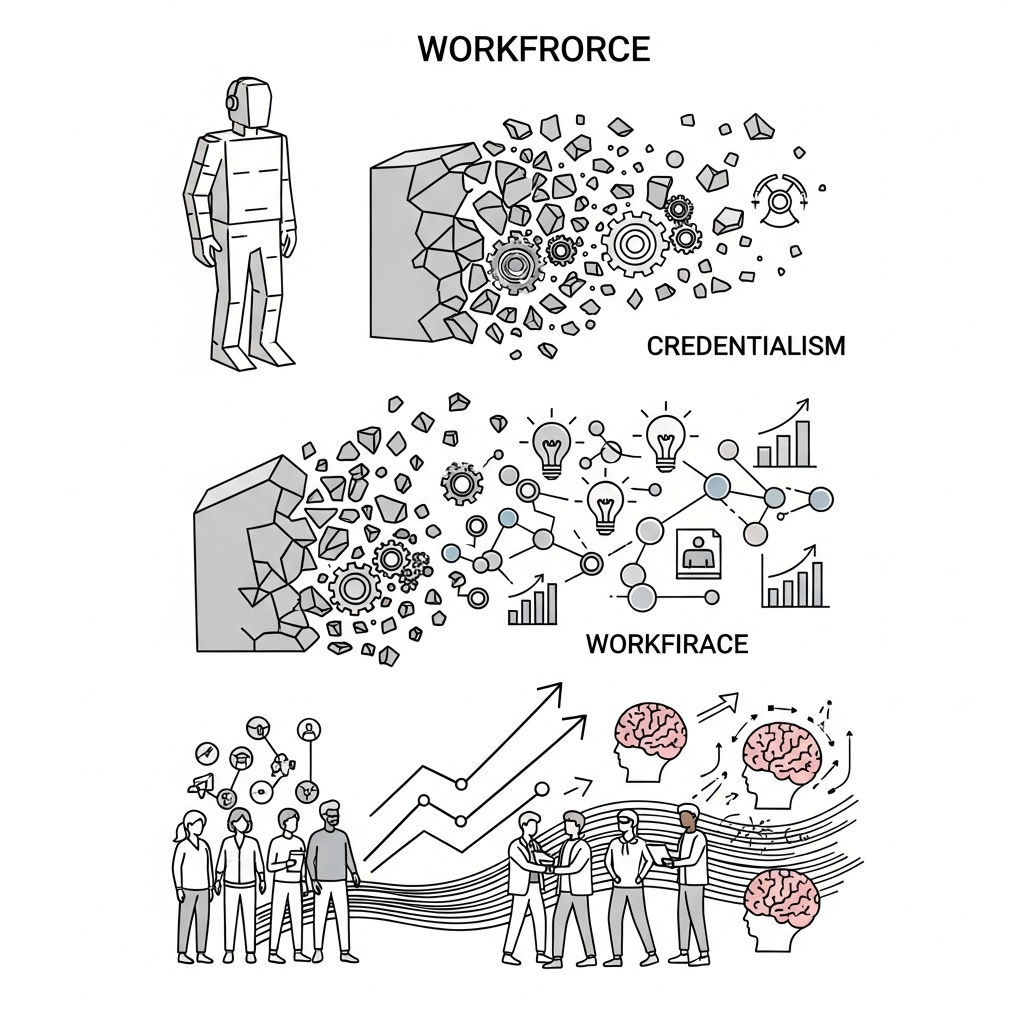
The journey doesn’t end with the hire. In a rapidly evolving economy, a truly resilient workforce is one that is continuously learning and adapting. If “data is all around,” as a more nerdy version of Wet Wet Wet might sing, then skills are your organization’s lifeblood, constantly needing replenishment and refinement.
Internal Talent Development and Mobility
The best talent might already be within your walls. Skills-based principles extend to internal mobility, allowing you to identify and nurture existing employees for new roles. Companies like Bristol Myers Squibb (BMS) have successfully implemented skills-based approaches that foster internal growth, recognizing that investing in your current workforce is often more efficient than constantly seeking external hires [21]. Implement:
- Internal Talent Marketplaces: Platforms that allow employees to discover new roles, projects, or mentorship opportunities based on their skills and career aspirations.
- Mentorship and Sponsorship Programs: Pair employees with experienced leaders to facilitate skill transfer and career progression.
- Clear Career Pathing: Provide transparent pathways for growth, outlining the skills and experiences needed to advance within the organization.
Upskilling and Reskilling for Evolving Demands
The pace of technological change, particularly with the rise of AI and automation, means that the skills needed today may be obsolete tomorrow. Proactive upskilling and reskilling initiatives are no longer optional; they are essential for survival.
- Skill Gap Analysis: Regularly assess the skills present in your workforce against future business needs. Identify critical skill gaps before they become crises.
- Targeted Training Programs: Develop or partner for training programs that directly address identified skill gaps. This could include technical bootcamps, soft skill workshops, or professional certifications.
- Micro-credentials and Digital Badges: Embrace shorter, focused learning opportunities that provide verifiable proof of specific skills, offering a flexible alternative to traditional degrees.
Fostering a Culture of Continuous Learning
Ultimately, building a future-proof workforce requires a fundamental cultural shift. It’s about embedding a learning culture where curiosity, adaptability, and growth mindsets are celebrated from the top down.
The OECD wisely cautions that focusing too narrowly on current skills needs may reduce long-term workforce adaptability if there’s inadequate support for continued learning [14].
- Leadership Buy-in: Leaders must model continuous learning and visibly support skill development initiatives.
- Time and Resources: Allocate dedicated time and resources for employee learning and development.
- Feedback Loops: Create systems for continuous feedback that highlight areas for skill development and recognize learning achievements.
This is the “Blueprint for a Skill-First Economy” – a holistic approach where education, industry, and government collaborate to systematically dismantle degree barriers and foster dynamic, competency-based pathways.
Implication: Long-term success hinges on continuous skill development.
Beyond initial hiring, a truly resilient and future-proof workforce requires ongoing investment in internal talent development, upskilling, and fostering a culture of continuous learning.
Key Takeaways
- Credential inflation and degree creep are systemic issues creating artificial barriers to talent, devaluing degrees, and exacerbating the global hiring crisis.
- The modern talent challenge is less about a ‘shortage’ and more about a ‘mismatch‘ between traditional hiring models and available skills, leading to significant economic and social costs.
- Skills-based hiring is a strategic imperative that delivers measurable business benefits, including enhanced diversity, improved efficiency, higher retention rates, and increased organizational resilience.
- Implementing skills-based recruitment requires a systematic approach: auditing job requirements, developing robust competency profiles, and leveraging innovative assessment tools and technology.
- True workforce resilience extends beyond initial hiring; it demands continuous investment in internal talent development, proactive upskilling/reskilling, and fostering a pervasive culture of continuous learning.
The era of blind credentialism is fading. The future belongs to organizations that prioritize demonstrable skills, fostering environments where talent is recognized, nurtured, and empowered, regardless of how or where it was acquired. Mastering skills-based hiring isn’t just about overcoming a crisis; it’s about building a more equitable, efficient, and ultimately, more successful future for your organization.
Ready to transform your talent acquisition strategy and unlock a wider talent pool of skilled professionals? Start your skills-based hiring journey today by auditing your job requirements and investing in competency-focused assessments.
This article provides general information and guidance on HR and talent acquisition strategies. It is not intended as a substitute for professional legal, financial, or human resources advice. Consult with qualified professionals for specific organizational needs.
Frequently Asked Questions
What is the difference between credential inflation and degree creep?
Credential inflation broadly refers to the devaluation of educational degrees due to an oversupply of graduates, leading employers to demand higher credentials for roles. Degree creep is a specific manifestation where degree requirements expand into jobs that historically didn’t need them, often for roles that can be performed with vocational training or experience, effectively raising the bar unnecessarily.
How does skills-based hiring benefit diversity and inclusion?
By focusing on demonstrable competencies rather than traditional degrees, skills-based hiring removes arbitrary barriers that disproportionately affect underrepresented groups. This broadens the talent pool, allowing employers to access highly skilled individuals who may not have a four-year degree, thereby fostering a more diverse and inclusive workforce that brings varied perspectives and experiences.
What are the main challenges in implementing skills-based hiring?
Key challenges include gaining buy-in from hiring managers accustomed to traditional methods, accurately measuring and assessing diverse skills, updating outdated job descriptions, and integrating new technologies and processes. It also requires a significant cultural shift within the organization towards valuing practical abilities and potential over formal credentials.
Can technology like AI help with skills-based hiring?
Yes, AI and other HR technologies can significantly support skills-based hiring by automating skill assessments, analyzing candidate profiles for relevant competencies, and identifying potential biases in job descriptions. However, it’s crucial to ensure these tools are designed and used ethically to avoid perpetuating or amplifying existing biases, as highlighted by organizations like the OECD.
References
- Sigelman, M., Fuller, J., & Martin, A. (n.d.). Skills-Based Hiring: The Long Road from Pronouncements to Practice. https://www.hbs.edu/managing-the-future-of-work/Documents/research/Skills-Based%20Hiring.pdf
- Wikipedia. (n.d.). Credentialism and degree inflation. https://en.wikipedia.org/wiki/Credentialism_and_degree_inflation
- Gillen, A. (2020, August 3). Credential Inflation: What’s Causing It, and What Can We Do About It? James G. Martin Center for Academic Renewal. https://jamesgmartin.center/2020/08/credential-inflation-whats-causing-it-and-what-can-we-do-about-it/
- Goodwin University. (n.d.). Degree Inflation. https://www.goodwin.edu/glossary/degree-inflation
- Cooper, P. (2023, November 28). College Degree Requirements Creep Into Lower-Income Brackets. Forbes. https://www.forbes.com/sites/prestoncooper2/2023/11/28/college-degree-requirements-creep-into-lower-income-brackets/”
- Seaman, P. B., Bell, M. J., & Trauntvein, N. (2017). The Credential Economy and the Job Marketplace. Research Starters – Education. EBSCO. https://www.ebsco.com/research-starters/education/credential-economy-and-job-marketplace
- Lucas James Talent. (n.d.). Is Overqualification Just as Problematic as Underqualification? https://lucasjamestalent.com/is-overqualification-just-as-problematic-as-underqualification/
- Indeed. (n.d.). How to Answer “Are You Overqualified for This Job?”. https://www.indeed.com/career-advice/finding-a-job/overqualified-for-job
- Goodwill Industries International. (n.d.). How to Overcome Being Overqualified. https://www.goodwill.org/blog/career-and-financial-advice/how-to-overcome-being-overqualified/
- Cornerstone OnDemand. (n.d.). The Most Unnecessary Job Posting Requirement: A College Degree. https://www.cornerstoneondemand.com/resources/article/most-unnecessary-job-posting-requirement-college-degree/
- Paychex. (n.d.). Worker Shortage and Hiring Struggles. https://www.paychex.com/articles/human-resources/worker-shortage-hiring-struggles
- HR Dive. (n.d.). The global hiring boom is here, and it’s solving the talent crisis. https://www.hrdive.com/spons/the-global-hiring-boom-is-here-and-its-solving-the-talent-crisis/
- OECD Centre for Skills. (2025). Empowering the Workforce in the Context of a Skills-First Approach. OECD Publishing. https://www.oecd.org/content/dam/oecd/en/publications/reports/2025/06/empowering-the-workforce-in-the-context-of-a-skills-first-approach_0e3be363/345b6528-en.pdf
- SZC Group. (2024, July). Skills Mismatch: Trends, Implications, and Solutions – A Canadian Focus. https://www.szc-group.com/wp-content/uploads/2024/07/Skills-Mismatch-Trends-Implications-and-Solutions-A-Canadian-Focus.pdf
- Equalture Blog. (n.d.). Determining Job Requirements: A Guide for HR Professionals. https://www.equalture.com/blog/determining-job-requirements/
- Toggl Blog. (n.d.). Job Requirements: What They Are, Why They Matter, and How to Write Them. https://toggl.com/blog/job-requirements
- Phys.org. (2025, July 9). The void for young US college graduates: An employment crisis. https://phys.org/news/2025-07-void-young-college-employment-crisis.html
- Built In. (n.d.). How to Write Job Requirements: Tips & Examples. https://builtin.com/recruiting/job-requirements
- SHRM. (n.d.). Transforming HR: The Rise of Skills-Based Hiring and Retention Strategies. https://www.shrm.org/labs/resources/transforming-hr-the-rise-of-skills-based-hiring-and-retention-strategies
- Central Test. (n.d.). Competency-Based Recruitment: Why It’s Important. https://www.centraltest.com/blog/competency-based-recruitment-why-it-important
- HeadStart.gov. (n.d.). Introduction to Competency-Based Hiring. https://headstart.gov/human-resources/article/introduction-competency-based-hiring
- Criteria Corp. (n.d.). 3 Ways to Trim Down the Requirements in Your Job Descriptions. https://www.criteriacorp.com/blog/3-ways-to-trim-down-the-requirements-in-your-job-descriptions
- Recruiterflow Blog. (n.d.). 10 Unconventional Recruitment Methods Top Recruiters Use. https://recruiterflow.com/blog/10-unconventional-recruitment-methods-top-recruiters-use/
- AIHR. (n.d.). The Selection Process: A Practical Guide for HR Professionals. https://www.aihr.com/blog/selection-process-practical-guide/
- Radancy Blog. (2025, March 7). Skills-Based Hiring: Why It’s Time to Rethink Credentials and Experience. https://blog.radancy.com/2025/03/07/skills-based-hiring-why-its-time-to-rethink-credentials-and-experience/”


